
«“Please give me the name of your florist, Madame, so that I can have your favorite flowers sent to you.”
“It is Cartier, Sir”
Quoted in the daily newspaper Sud-Ouest, 1954.

Right from the founding of Cartier in the mid-nineteenth century and throughout the firm’s history, floral motifs have been inseparable from the jeweler’s artistic inclinations. They can be seen in the garland-style designs of the Belle Époque as well as in the flower-pot sculptures of the early twentieth century. They then resurfaced with the fashion for “Hindu” jewelry (later dubbed Tutti Frutti) and during the naturalist trend launched by Jeanne Toussaint in the mid 1930s. Flowers still serve as a source of inspiration today. Not just individual blooms but also leaves, baskets of flowers, bouquets, palm trees, etc., are an extensive part of Cartier’s vocabulary.
The garland style’s floral idiom
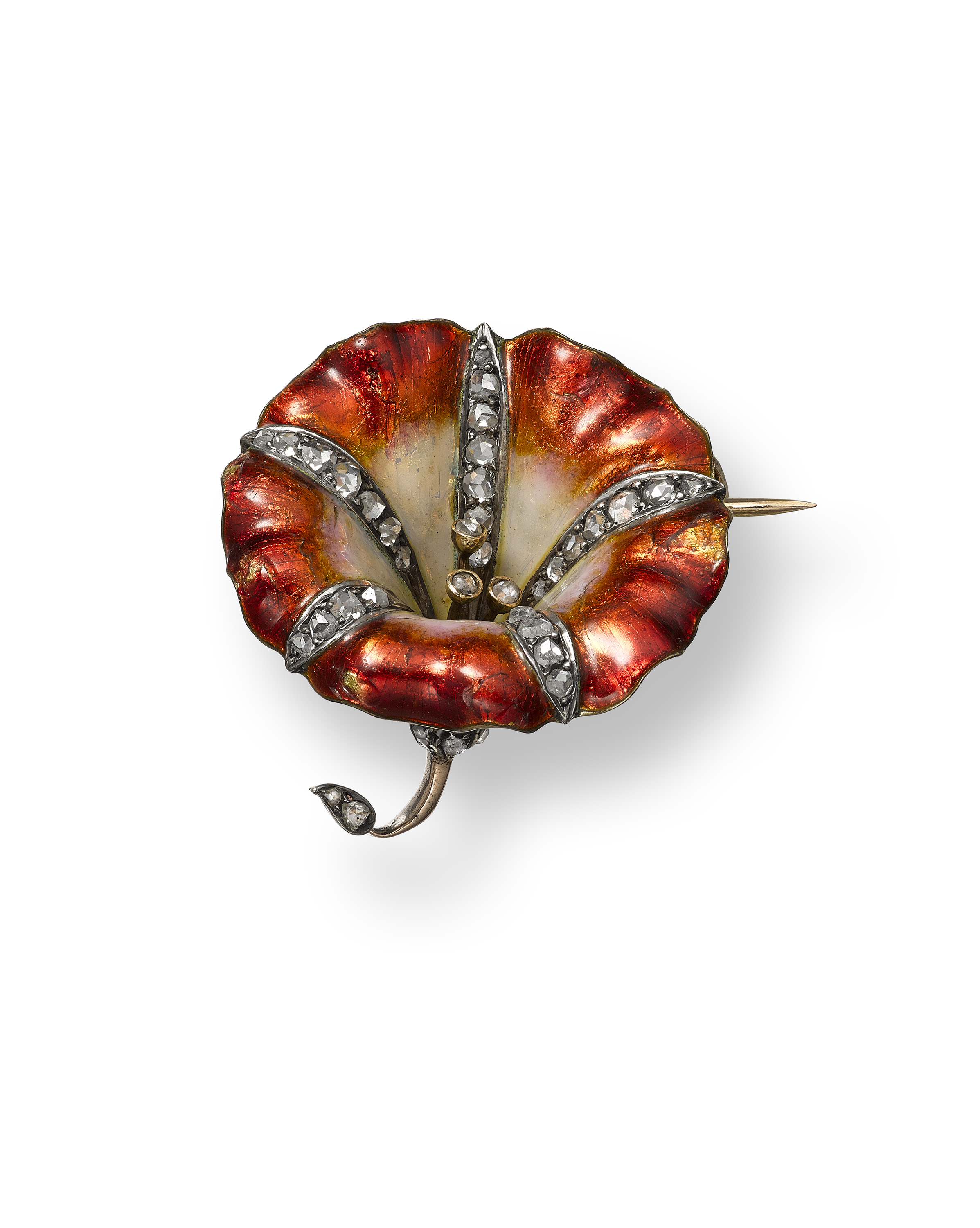
The first explicit reference to a flower in the company archives dates to 1860: in the stock ledger for November of that year were earrings decorated with pansies in mosaic. In the 1870s there were several other flowers of that family, mainly on buttons and earrings of similar type. The ledger for 1873, meanwhile, listed an “enameled eglantine brooch.” Given the incomplete nature of company archives for that period, however, it is probable that other flower brooches were made by Cartier in the early years, such as a gold and enameled silver “Convolvulus” brooch now in the Cartier Collection.
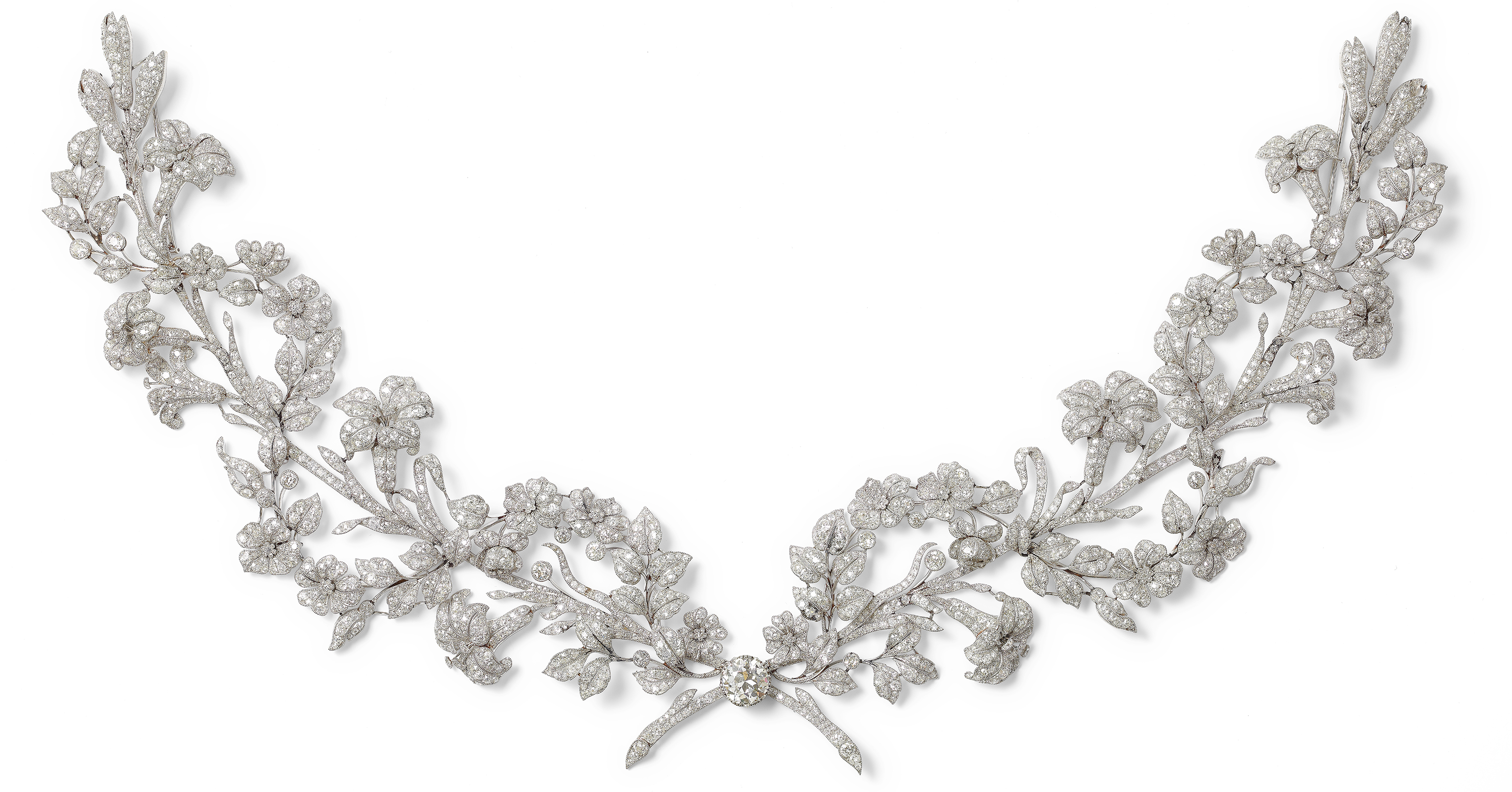
In the late nineteenth and early twentieth centuries, Cartier became famous for its garland style, harking back to the eighteenth century and the reign of Louis XVI (1754–1793), which Louis Cartier considered the height of French classicism. The imagery evoked by garland-style jewelry made of platinum and diamonds included not just classical architecture and decorative bows and trimmings, but also a profusion of foliage: scrolls, garlands of flowers, laurel and olive leaves, palm leaves and palmettes, and numerous floral specimens ranging from lilies to wisteria. In these designs, however, floral themes were not autonomous motifs, but were rather used for their decorative potential.
Potted flower sculptures
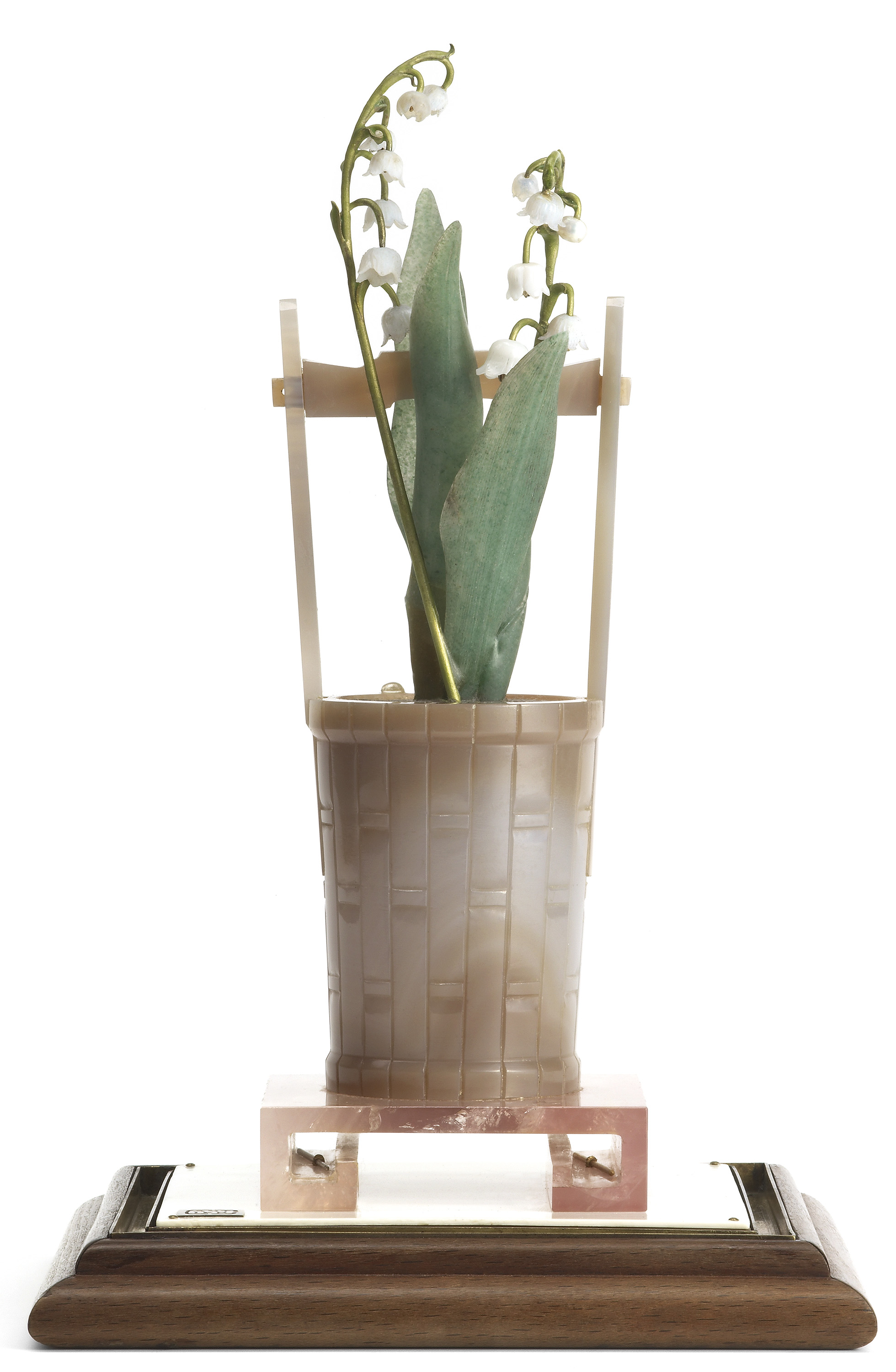
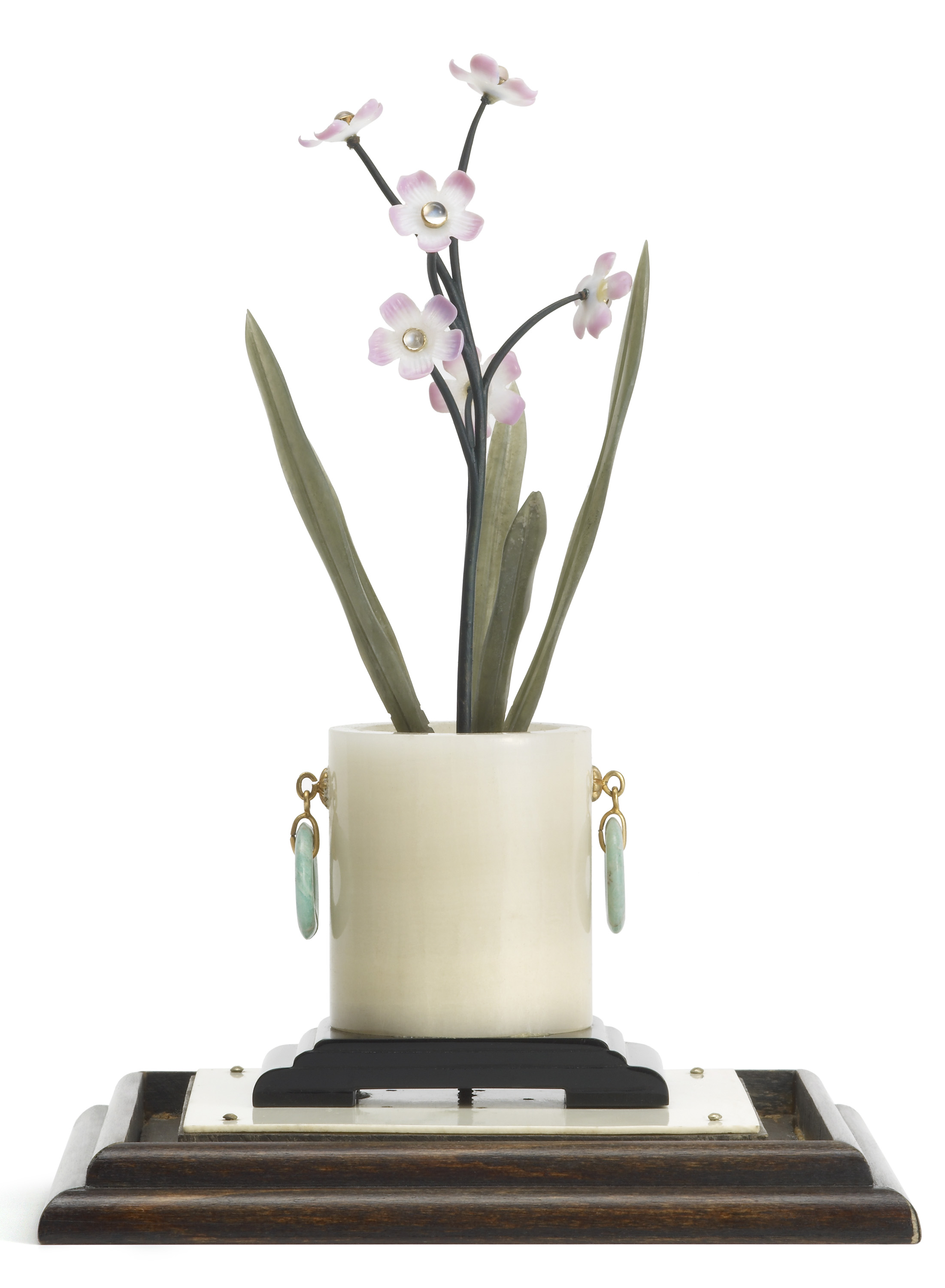
The earliest of these pieces were contemporary with the garland style, yet opened a new chapter of Cartier’s foliate history. They were decorative objects in the form of floral compositions, sometimes displayed in a case of glass or crystal, set on a wooden base. Depending on the period, they would be made of various materials: the flowers were usually enamel, the leaves made of aventurine, and the pot of red jasper, while drops of drew might be represented by moonstone cabochons. The earth was depicted by a varied range of stones including chrysoprase, rubellite, obsidian and jade.
The wide variety of flowers constituted a veritable botanic encyclopedia: lilies, arums, poppies, irises, hydrangeas, magnolias, orchids, lilac, pansies, marvel of Peru, and even cactuses, to name just a tiny selection. The cactuses were made in the New York workshop, which produced them for stock in the late 1902s, whereas the great majority of the other flowers were made in Paris. A very few were also made in London.
In the 1910s it was even suggested that collections of several varieties be placed in “greenhouses”—which were probably large display cases, in fact. King Alfonso XII of Spain (1886–1941) bought an electrified display case containing seven species.
The number of such sculptures remains modest in terms of Cartier’s global history—between 1907 and 1937 there are fewer than 200 references in total. They nevertheless reflected a broader trend, namely Russian influence on Cartier, who emerged as an established rival to Pierre-Karl Fabergé (1846–1920) in the early twentieth century.
In an exotic garden
The early sets of potted flowers notably reflected the tradition of Japanese ikebana, or art of flower arrangement, as indicated by the choice of species sculpted, such as Japanese magnolia and Japanese crabapple. In fact, Cartier’s entire floral repertoire is tinged with exoticism.
Tutti Frutti
One of the most eloquent examples of this exoticism is the Tutti Frutti jewelry dating back to the 1920s. It was exotic less for the underlying “tree of life” theme (shared by many cultures) than for its allusions to India via the use of carved, colored stones. In the Indian manner, these sapphires, emeralds and rubies were carved and engraved with floral motifs, composing dense, multicolored foliage that sprouted on brooches, bracelets, necklaces, earrings and even decorations on evening bags. In those years, the goal was not so much a faithful reproduction of the plant world as a joyous evocation of ever-fertile nature. It was not until the following decade that a naturalist trend fully emerged.
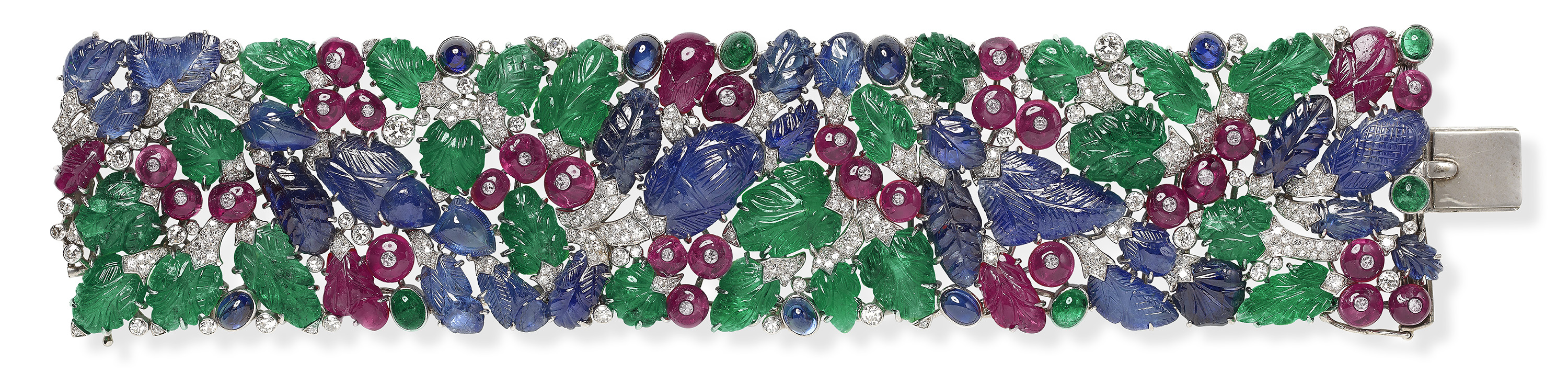
This style survives even today—in a revisited form—remaining central to Cartier’s grand floral designs. The lavishness of Tutti Frutti jewelry has never waned, like the so-called “Rajasthan” necklace. This bib necklace is orchestrated around a central, carved emerald weighing 136.97 carats, and employs the traditional yet timeless trio of colors—green, red and blue—even as it demonstrates Cartier’s extreme technical prowess through a structure enabling it to be worn three different ways.
Exotic strains
Exoticism also arises from the flowers invoked: wisteria, Japanese cherry, peony, bamboo and lotus all reflect the Far-Eastern influences so important to the Cartier brothers, as do the “Chinese vase” brooches and other baskets of flowers evoking floral arrangements in the Asian manner.
Orchids
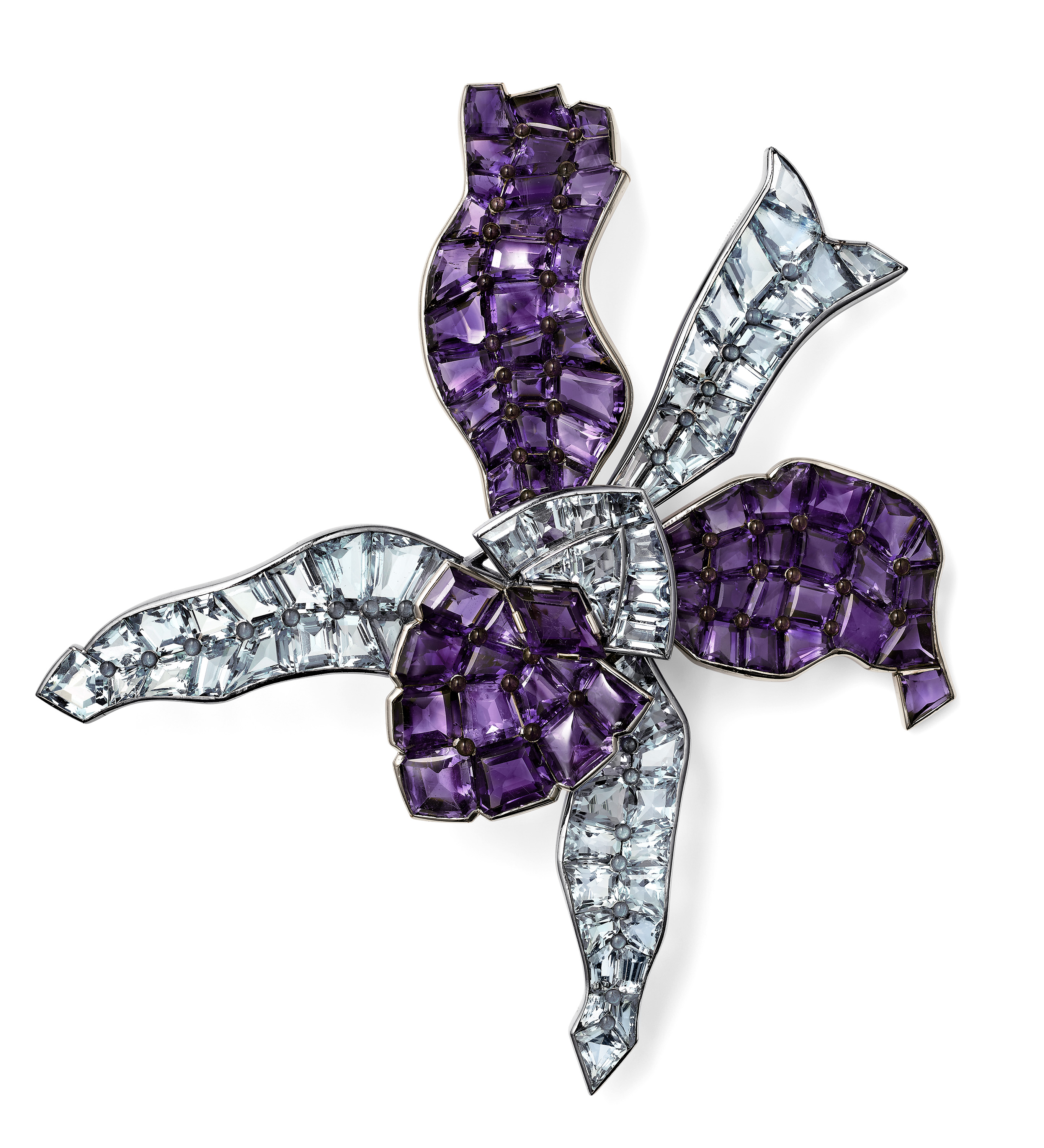
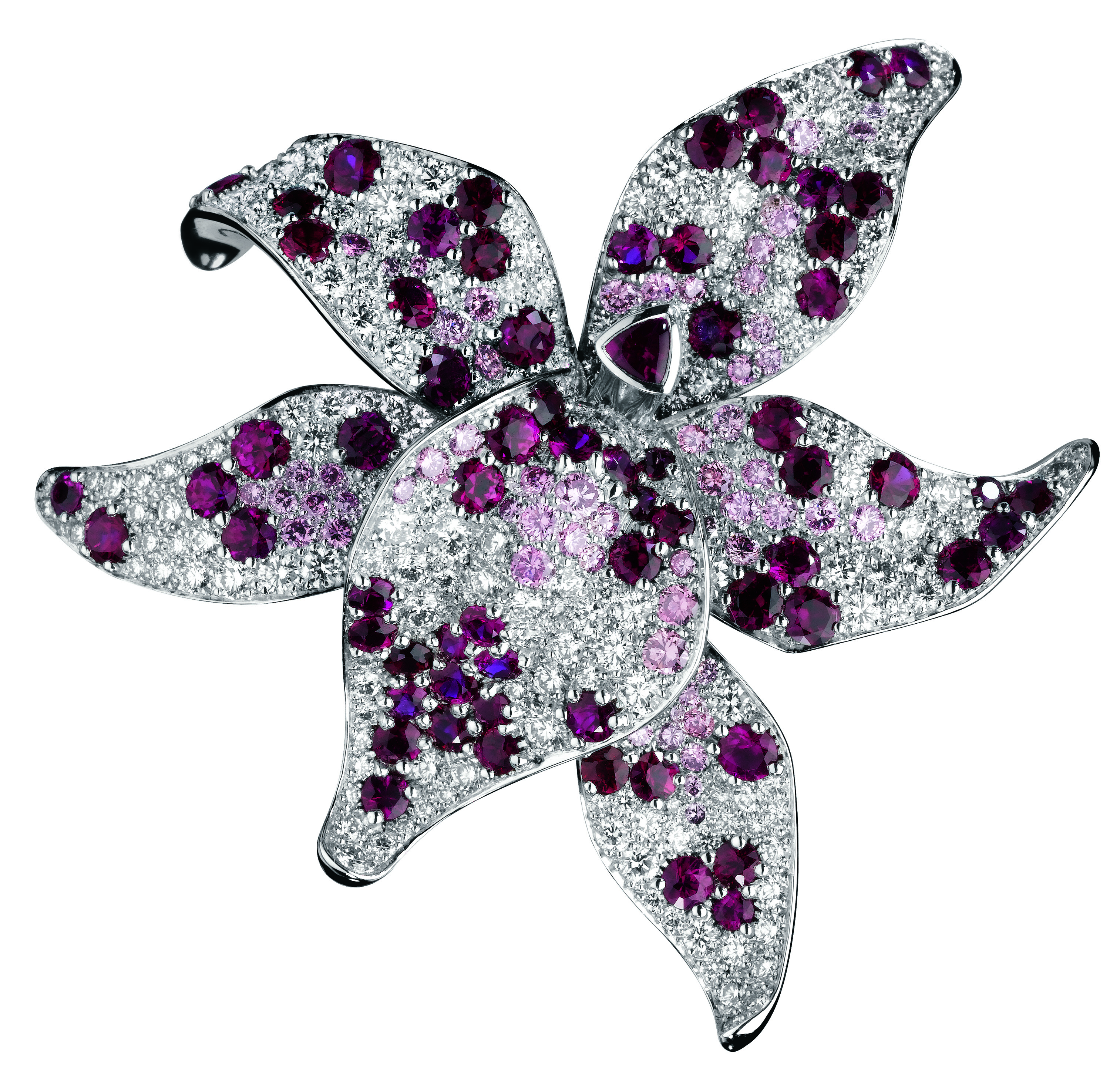
Orchids hold pride of place in Cartier’s exotic garden. They could already be seen on a head ornament known as a bandeau-comb, exhibited at the 1925 Art Deco show in Paris (Exposition Internationale des Arts Décoratifs et Industrials Modernes): two orchids composed of onyx and diamonds frame the head ornament. Later, a brooch made in 1937 and now in the Cartier Collection, reinvigorated the theme in a new way. Amethysts and aquamarines, reflecting the vogue for colored stones during the interwar period, were used for the petals of the spidery orchid. Contemporary designs extend this tribute to the delicate flower. In 2005, the Caresse d’Orchidées line triumphed with this theme. Emblematic of that line was a necklace of several strands of 189 emerald beads, with a ruby and rubellite orchid at its center. The very shape of the necklace suggested fertile, untamed nature in what was still a controlled environment conducive to the blossoming of this very special flower.
Naturalism versus poetry
The late 1930s and early 1940s epitomized Cartier’s true commitment to exploring lines, three-dimensional volumes and movement. Spurred by Jeanne Toussaint, who headed design at Cartier since 1933, the language of flowers came to represent a special source of inspiration, as it still does today. The upshot was jewelry that was deliberately naturalistic, yet not devoid of poetry. Whereas shapes were faithful to nature, the hues of precious metals and stones often outdid nature to the benefit of bejeweled color. Designs occupied a line between naturalistic and poetic evocations of flora. Therein lies Cartier’s uniqueness: the ability to begin with jewelry’s standard botanical repertoire but then come up with a new, non-conformist interpretation of it, as demonstrated by a flower clip brooch, ordered in 1941, featuring a flower whose down-turned petals are presented in profile, while its fully articulated stem quivers when the brooch is worn.
An expression of skill
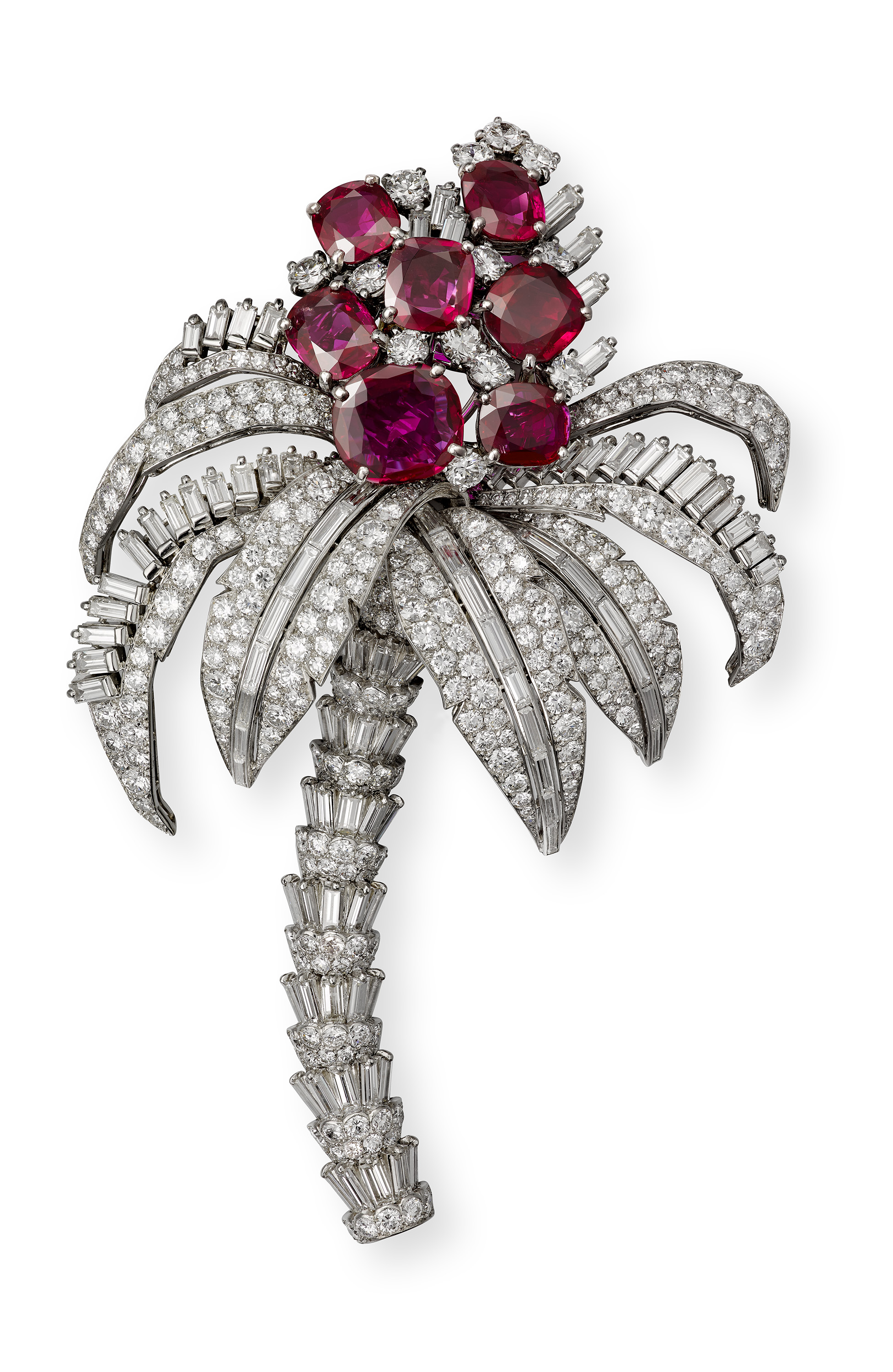
These floral compositions represent an expression of the skill of Cartier’s artisans. Flowers in particular testify to feats of technical prowess—some are fully articulated, whereas the settings of others are totally invisible. A Palm-tree clip brooch of 1957, now a key piece in the Cartier Collection, wonderfully illustrates the combination of unique appropriation of nature and perfect mastery of technique: seven Burmese rubies of outstanding quality represent the sparkling red fruit of a tree whose trunk is fully articulated. The use of different cuts of diamond imparts volume to the palm branches and breathes life into the tree. This subtle play on cuts of stone is typical of Cartier, and can be seen again on flowers set on platinum, such as a brooch that once belonged to Princess Margaret (1930–2002).
Roses
Roses have their own special chapter in the Cartier story. In 1938, the London workshop designed a platinum-and-diamond brooch in the form of a rose. As the emblematic flower of England, the brooch was worn in 1953 by the younger daughter of King George VI (1895–1952), Princess Margaret (whose second given name is Rose) at the coronation of her older sister, Queen Elizabeth II (1926–). Several different cuts of diamond, placed on an invisible setting, sketch the outlines of a three-dimensional rose: baguette-cut diamonds form the stem and edges of the petals, composed of round old-cut and single-cut diamonds.
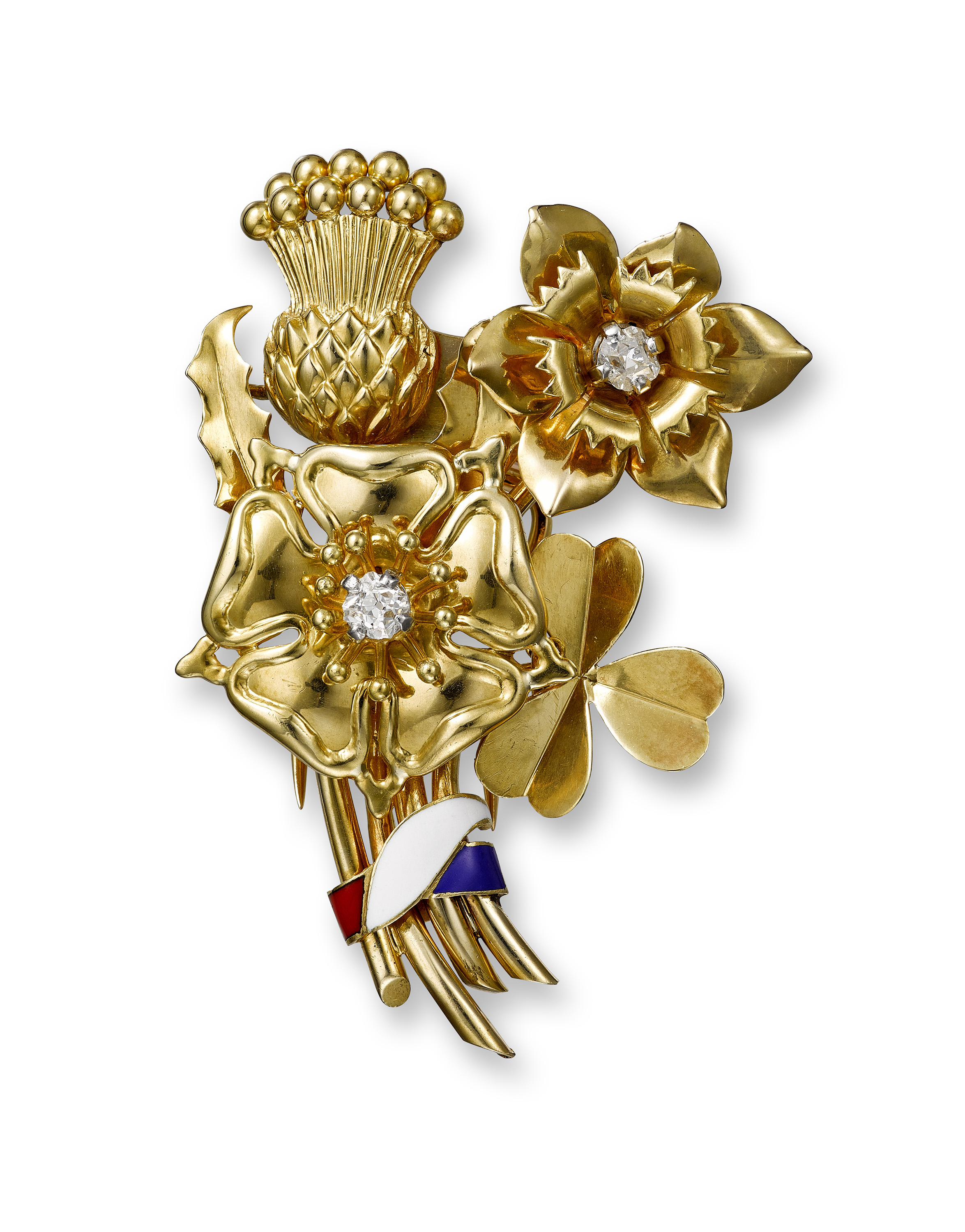
On another brooch also made in 1938, the rose is joined by a thistle, daffodil and shamrock, forming a bouquet that alludes to the four nations of the United Kingdom—England, Scotland, Wales and Northern Ireland. This brooch, which reflects the sustained link between Cartier and the court of Saint James’s, was made in a limited edition for an official visit of the British monarch to Paris that same year. In 1953, Queen Elizabeth II also called on Cartier’s London workshop to produce a special flower brooch—set with marquise-, brilliant- and baguette-cut diamonds, its petals surround the famous pink Williamson diamond.
In the 1930s, Cartier also designed playful little brooches depicting hands holding a rose, in combinations of gold and materials such as coral and black lacquer.
The language of flowers today
From the latter half of the nineteenth century up to the present, the floral theme has been a constantly refreshed source of inspiration for Cartier designers, whose creations flaunt the dexterity of the firm’s workshops. Thanks to this Cartier skill, theoretically conventional items of floral jewelry reveal powerful strength of character. Since the turn of the twenty-first century, the ancestral art of carving hard and precious stones, known as glyptics, has returned to the fore in Cartier workshops. In the hands of glyptic artists, chalcedony, amethyst, rubellite and morganite are transformed into delicate irises, orchids, and other flowers.
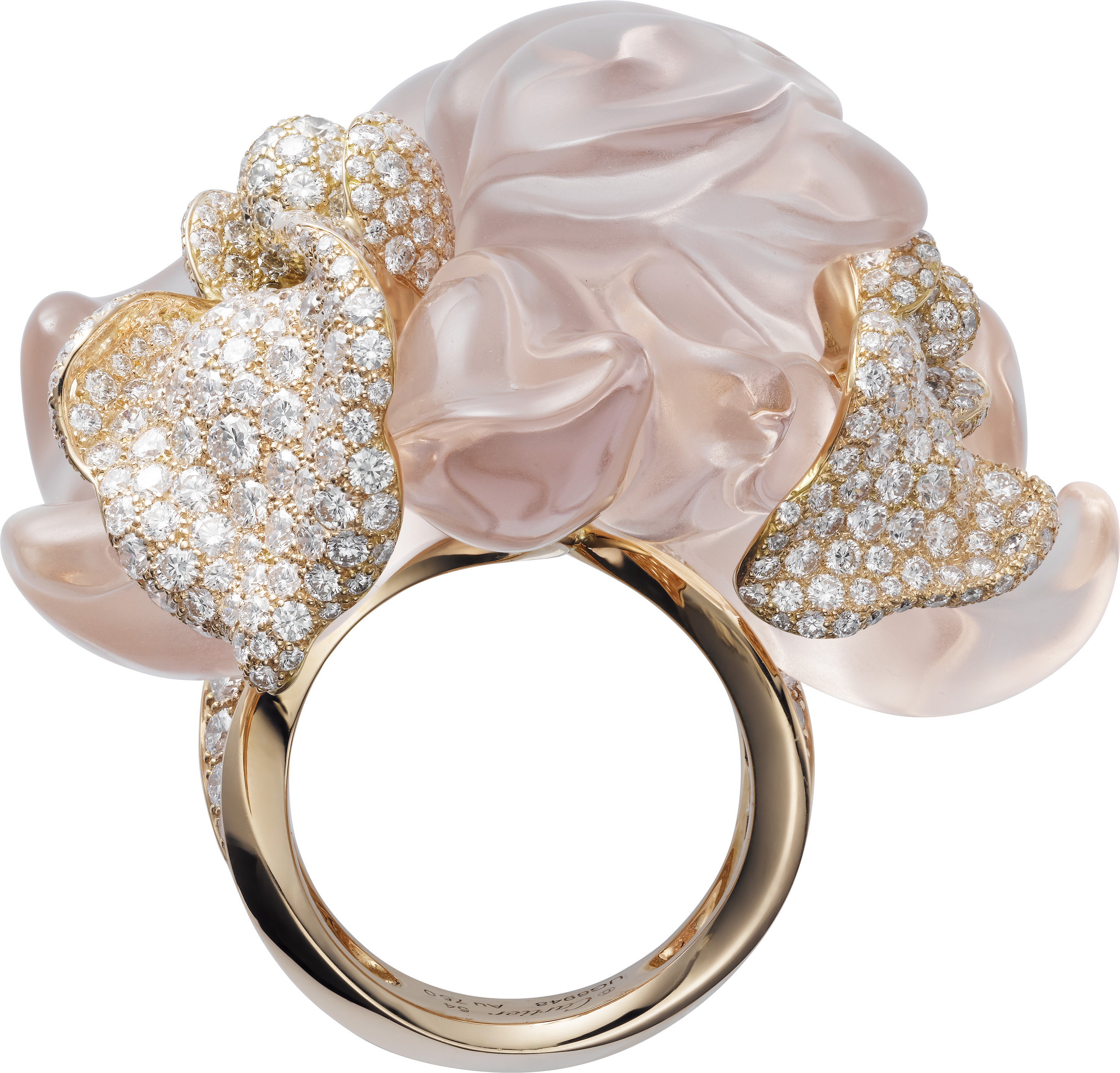
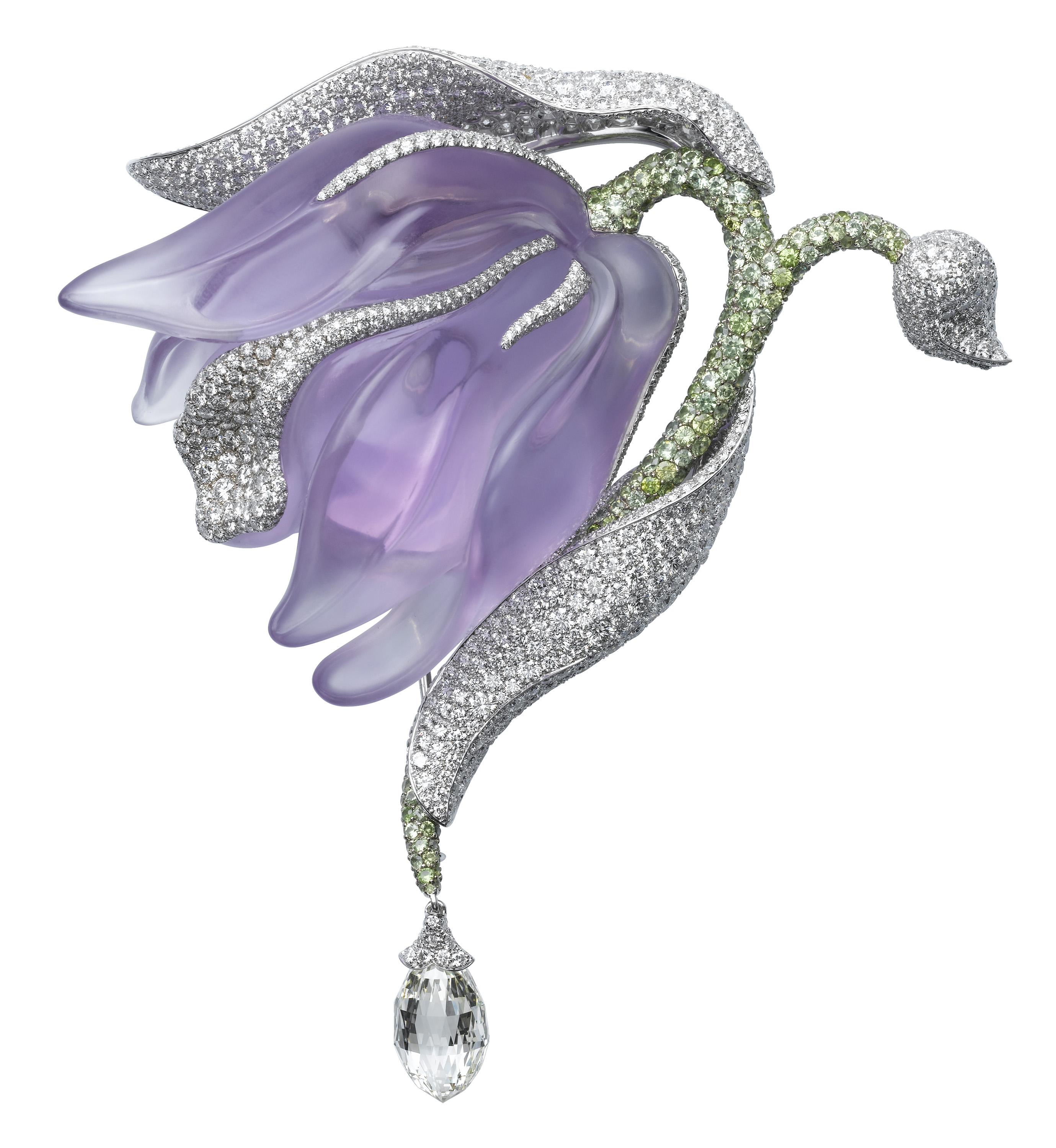
In 2016, the Cactus de Cartier line of jewelry took up a new challenge, namely making the prickliest of flowers seem succulent. Cartier used cactuses to exploit openwork volumes and sharp colors in which naturalism and whimsy were combined—as always—in just the right balance. Which, in short, typifies Cartier’s very own art of flower arrangement.