
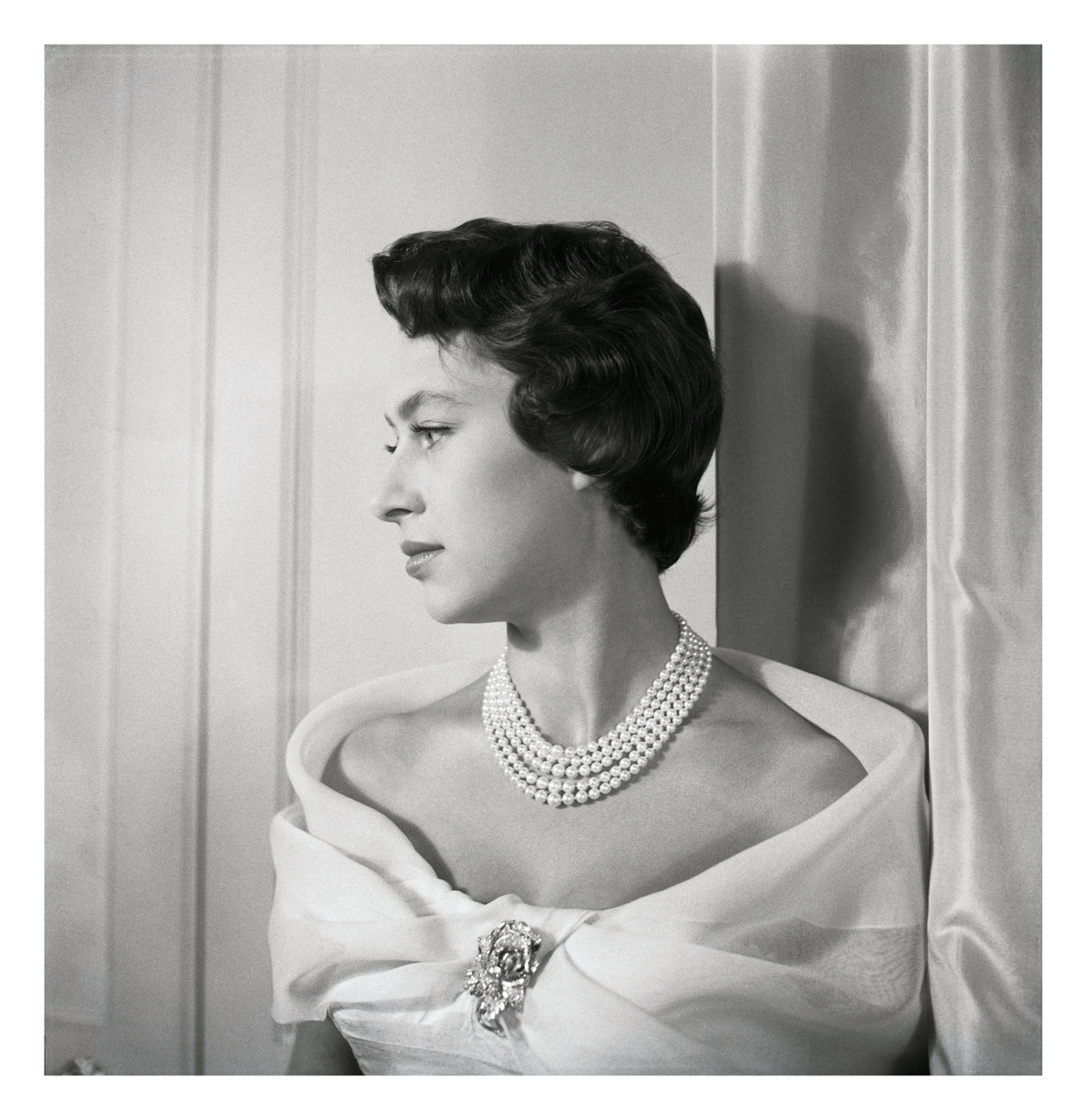
The sister of Queen Elizabeth II, Princess Margaret (1930–2002) showed a marked interest in jewelry throughout her life. Many of the items she wore either on an everyday basis or at official ceremonies were made by Cartier, and were often gifts from family or friends.
A quiet childhood
Little Margaret Rose was the first member of the British royal family in 300 years to be born in Scotland. The second daughter of the duke and duchess of York—hence granddaughter of King George V and Queen Mary—she was born on August 21, 1930, in Glamis castle, the ancestral home of her maternal grandparents, Claude and Cecilia Bowes-Lyon, earl and countess of Strathmore and Kinghorne. Margaret led a quiet life with her older sister, Elizabeth, dividing her time between 145 Piccadilly in London and Royal Lodge on the grounds of Windsor Castle.
A new life at court
But everything changed on December 11, 1936, when her uncle, King Edward VIII, abdicated in order to marry Wallis Simpson. Margaret’s father suddenly became King George VI, while her mother became Queen Elizabeth. The press began to pay much attention to the two little girls, who moved into Buckingham Palace with their parents. Shortly after, Margaret, aged eight, received what was probably her first piece of Cartier jewelry, namely a Giardenetto brooch that her father bought on September 9, 1938. It featured flowers of citrine, almandine garnet, peridot, and pink tourmaline sprouting from a little pot enameled to imitate terracotta.
During the war, the two sisters lived at Windsor Castle for safety. There the few jewels kept by their parents were given to them to celebrate family events.
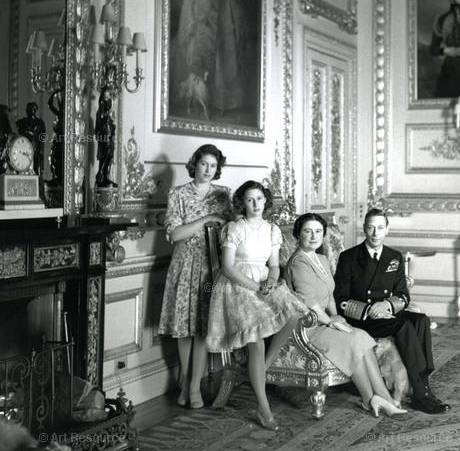
The sisters only returned to London in 1945. Margaret was fifteen, and already very popular. She sang, played the piano and displayed a livlier personality than her sister, who was aware of her future responsibilities. In 1947, Margaret was maid of honor at her sister’s marriage to Prince Philip of Greece and Denmark.
Margaret was later given a diamond flower clip-brooch with openwork petals and a ruby in the center, made by Cartier in 1948. The year she turned twenty, her mother gave her a Cartier gold and ruby watch, made in 1940, as a Christmas present. Whereas Elizabeth mainly received jewelry set with sapphires, Margaret was given many pieces that featured rubies.
In 1952 the princesses’ father died. Elizabeth, the elder of the two, succeeded to the British throne. She was crowned Queen Elizabeth II sixteenth months later.
A woman in love
Still single, Margaret feel in love with Peter Townsend, a former equerry to King George VI, who had already been married and was the father of two children. This romance, avidly followed by the press, did not have a happy ending. Given hostility to the idea of their marriage from politicians and the entire establishment, Margaret renounced the plan and issued a press release to that effect on October 28, 1955. Five years later, on May 6, 1960, she married British photographer Antony Armstrong-Jones in Westminster Abbey. In 1961 her husband was made earl of Snowdon, and that same year she gave birth to their first child, David, viscount Linley. To celebrate that event, her mother gave Margaret an oval Cartier brooch in platinum set with aquamarines, its tips patterned with pavé-set diamonds. Made back in 1932, this jewel was bought from Cartier in 1947. A second child, Lady Sarah, joined the family on May 1, 1964.
A royal collection
The earl of Snowdon regularly accompanied his wife on official trips abroad and during ceremonial functions in Britain. On October 15, 1975, Antony and Margaret were guests of honor at the opening of an exhibition held at Cartier London to celebrate the centenary of the birth of Louis Cartier. The presence demonstrated the Windsor family’s attachment to the French jeweler, its official supplier for generations.
After Margaret and Antony divorced in 1978, the princess devoted her time to her numerous charities. Most were related to music, ballet and the protection of children.
Margaret’s health began to weaken from 1985 onward, getting worse over the years. She died in London on February 9, 2002.
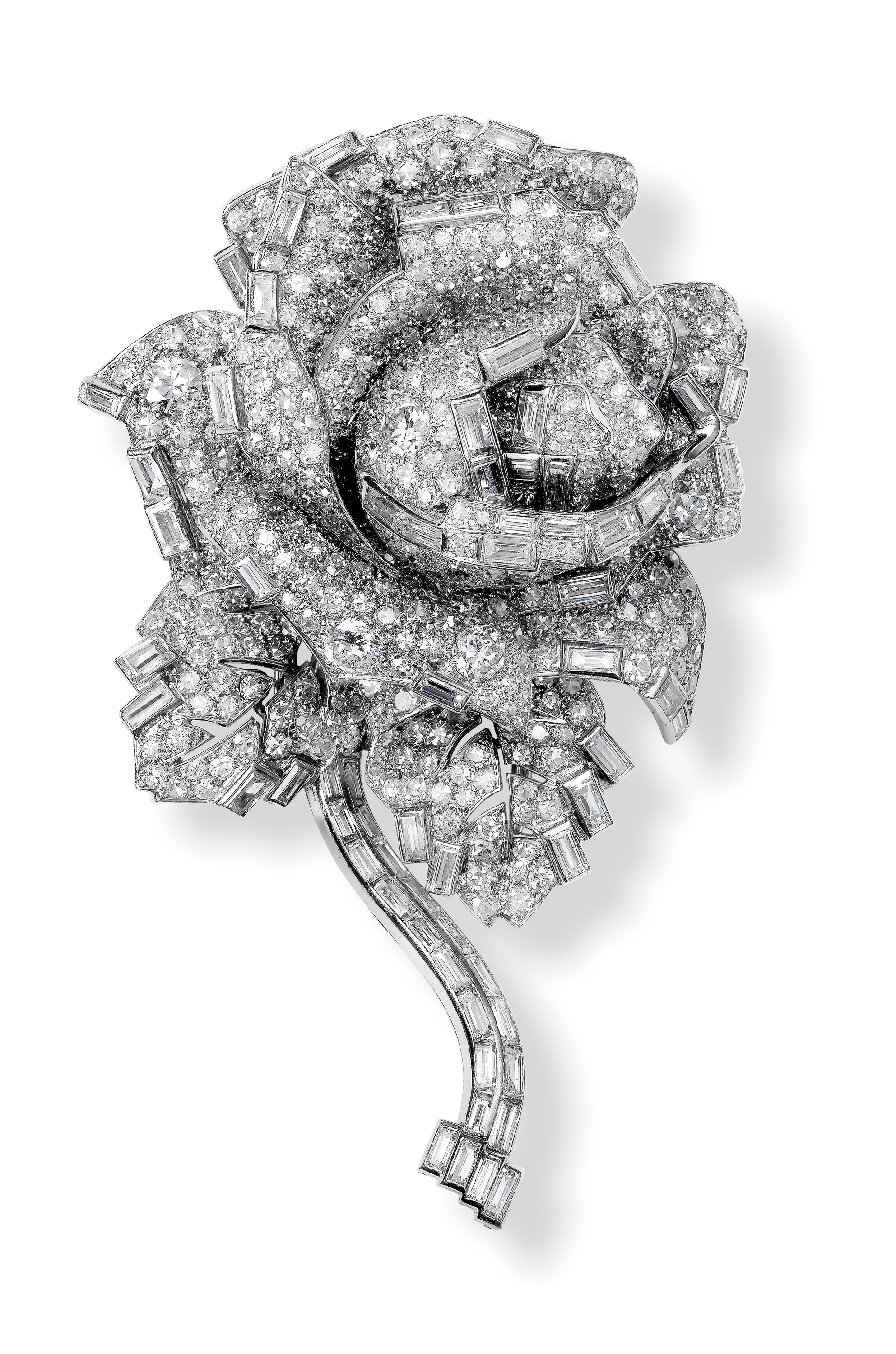
In 2006 a major London auction house organized the sale of part of her collection of jewels. The auction notably included a Cartier watch with hexagonal case made in 1911, diamond and ruby hair pins from 1907, a 1938 brooch featuring cabochon-cut rubies, a purse watch with sliding cover made in 1950, and a Oiseau libéré (free bird) brooch from 1986. Also worth mentioning, in the Art Deco vein, is a necklace with black silk cord from which hangs a plaque of carved jade. As a demonstration of Margaret’s fondness for floral motifs, one of the key items at the auction was a rose brooch with tight pavé-set petals designed in 1938.
This clip-brooch was worn by Princess Margaret the day her sister was crowned, as well as for a portrait taken by the famous photographer Cecil Beaton. The brooch now belongs to the Cartier Collection.