
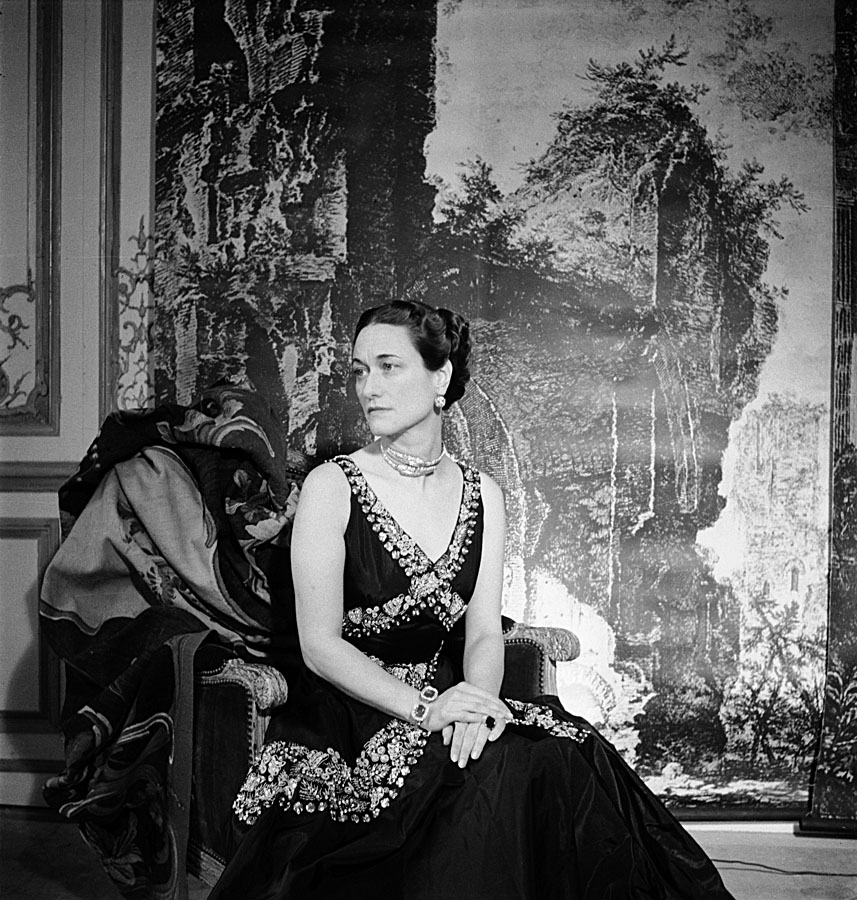
“Love,” the poet Byron wrote, “is a woman’s whole existence.” This famous maxim perfectly applied to the Duchess of Windsor, who even cited it at the end of her memoirs. In the minds of everyone she is forever associated with the Duke of Windsor, briefly King Edward VIII, who renounced the British throne in order to marry her. The couple they formed, united by Cartier jewelry, would go down in history.
From Baltimore to London
Bessie Wallis Warfield was born in 1896 in the United States. Thanks to support from her uncle, the girl who had lost her father could enter respectable Baltimore society. The summer when she was twenty she met Earl Winfield Spencer, a U.S. Navy flyer. Married in the fall of 1916, the couple moved regularly, depending on his various postings, from Florida to China. But the marriage didn’t last and they divorced in 1927.
The next year Wallis married Ernest Simpson, a shipping executive. They lived in England, enjoying London society life and moving in the highest British social circles. Wallis, noted for her refinement and confident sense of taste, attended every party and social event.
WE
It was during one of those events, in 1931, that Wallis met Edward, Prince of Wales. They met again on several occasions, then more and more often, up until 1934, at which point their relationship could no longer be ignored. Edward’s father, King George V, firmly disapproved. It was unthinkable that his son, the future king and hence future head of the Church of England, should be dating a divorced woman. The young prince stood up to his father.
To demonstrate his affection for Wallis while remaining somewhat discreet, he gave her a piece of jewelry as simple as it was personal—a little cross of platinum, made by Cartier in 1934. Eight other crosses followed, up to 1944, put together on a bracelet. Set with aquamarines, emeralds, rubies, yellow sapphires, amethysts, and baguette-cut diamonds, each was dated and engraved on the back with a private message marking a personal event.
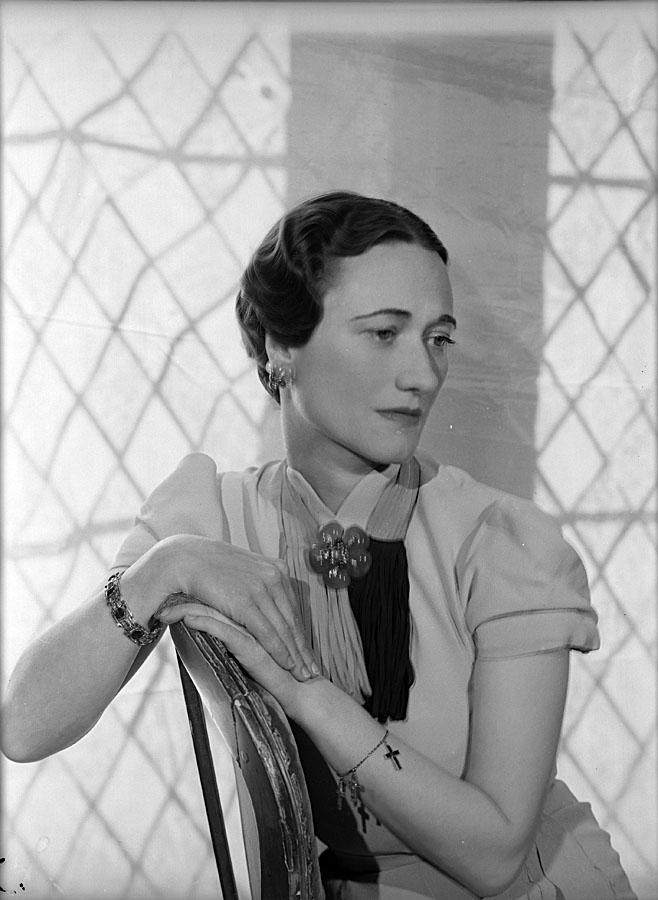
One motif, engraved on the first cross in 1934, recurred regularly: the letters W and E, representing each of their initials, joined together to form the word “WE.” This powerful symbol notably appeared again on a brooch of 1935 in a design as lavish as it was geometric, the W being composed of sapphires and the E of rubies.
Abdicating for love
The very next year, the couple had to confront history. The death of his father in January 1936 thrust the Prince of Wales upon the British throne. He adopted the regal name of Edward VIII. However, aware that his status of monarch would prevent him from marrying the woman he loved, he renounced his crown and abdicated in favor of his brother on December 16, 1936.
Freed from official duties, the new Duke of Windsor joined Wallis in France. Recently divorced from Ernest Simpson, she was living in the Château de Candé, where the couple was formally wed in June 1937. As an engagement ring, the duke gave Wallis—henceforth Duchess of Windsor—a gold ring topped by a 19.77-carat emerald, made by Cartier.
“Windsor style”: classic yet exotic
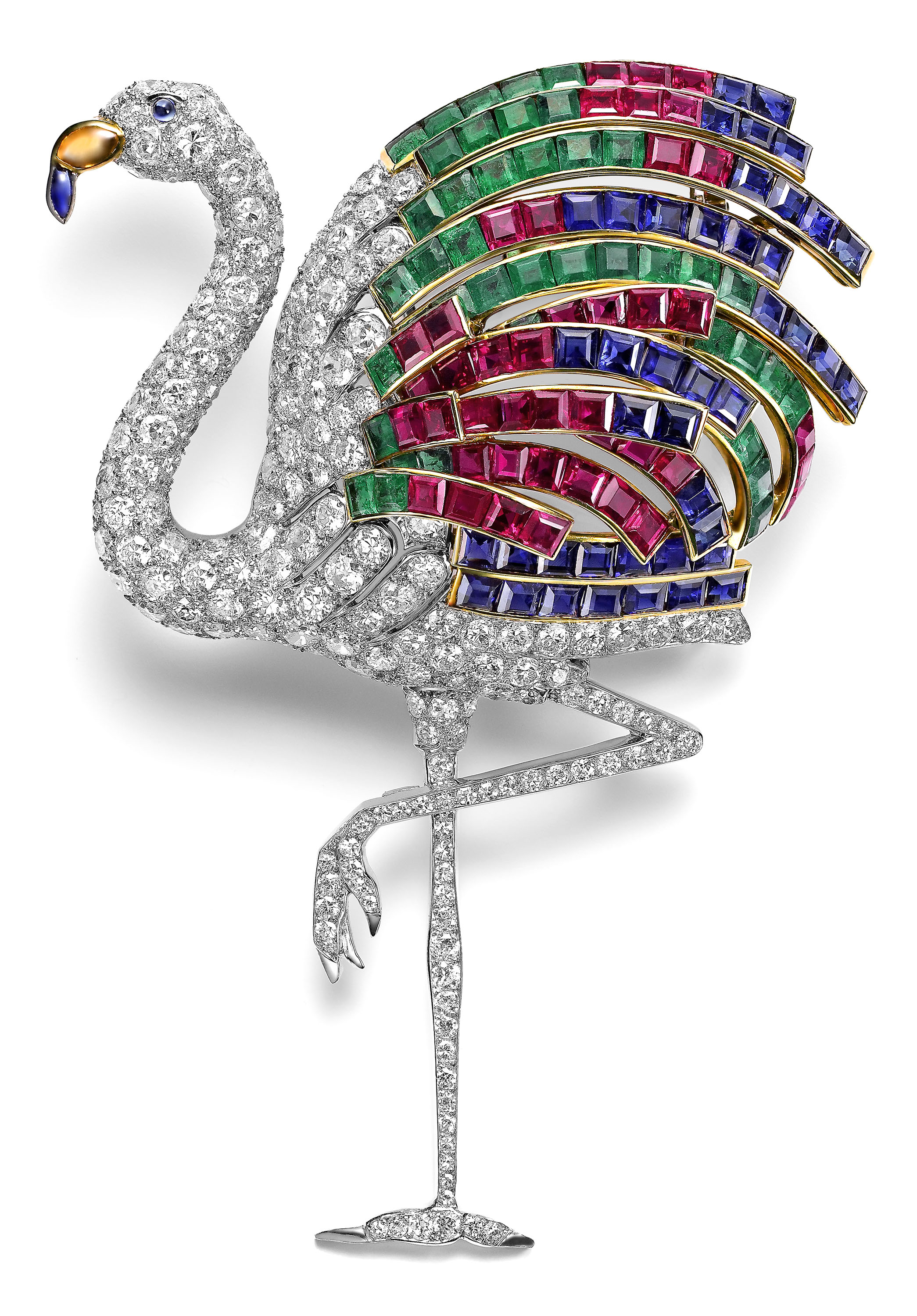
The Windsor couple had only limited official duties, and thus led a social life of sophistication and elegance. Wallis made a splash with her Cartier jewelry, as witnessed by a famous photograph of the couple taken in 1940, one of their first official pictures. It shows the duke and duchess side by side in a garden in Hamilton, Bermuda; on the lapel of her jacket is a flamingo brooch whose feathers shimmer with sapphires, emeralds and rubies. This gift from her husband had been bought that same year from Cartier.
This creative design reflected the duchess’s style—classic yet exotic. This style is reflected in two other extraordinary items. One is a spectacular necklace ordered by the duke from Cartier Paris in 1947; evoking Oriental drapery, it was made of amethysts supplied by the couple, alongside turquoises. The duke was personally involved in its creation by making suggestions to the designers. This detail alone indicates the special relationship between Cartier and its famous client.
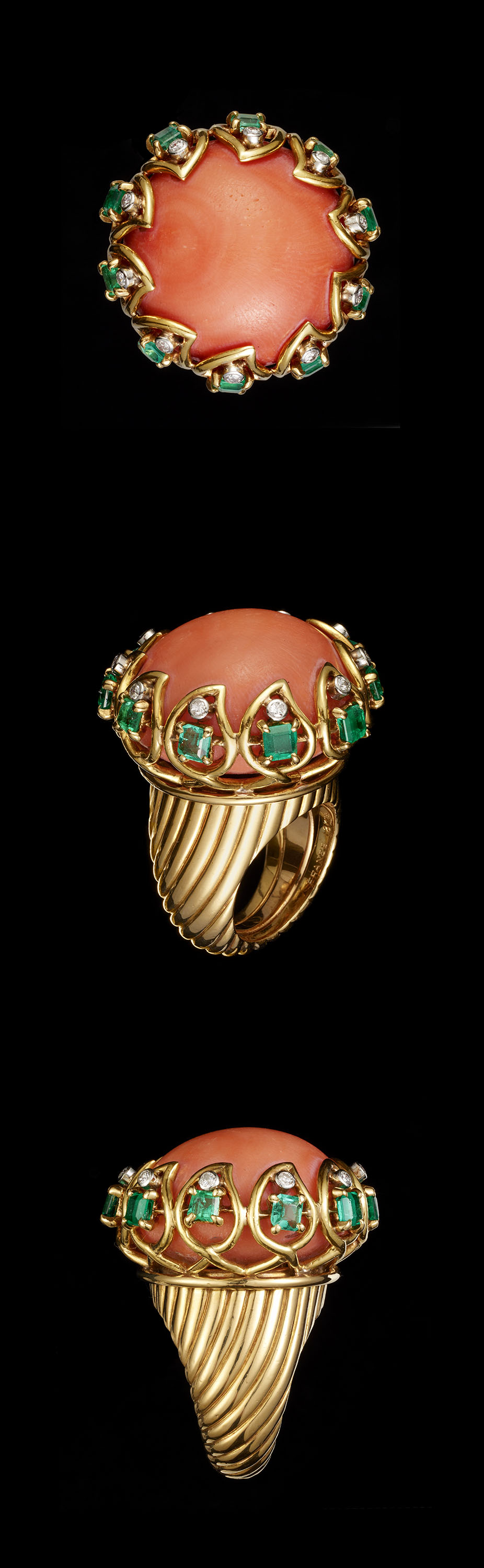
A second example of the duchess’s highly distinctive taste, which Cartier Paris helped to forge, can be seen in a ring of 1947. Once again the design involved a bold combination of strong colors, an emblematic approach adopted by Cartier in the early twentieth century: a ring of twisted yellow gold was capped by a coral cabochon surrounded by emeralds, in a very Oriental combination.
A panther for alter ego
The duchess was one of the first clients to fall for the magnetic personality of Cartier’s iconic panther.
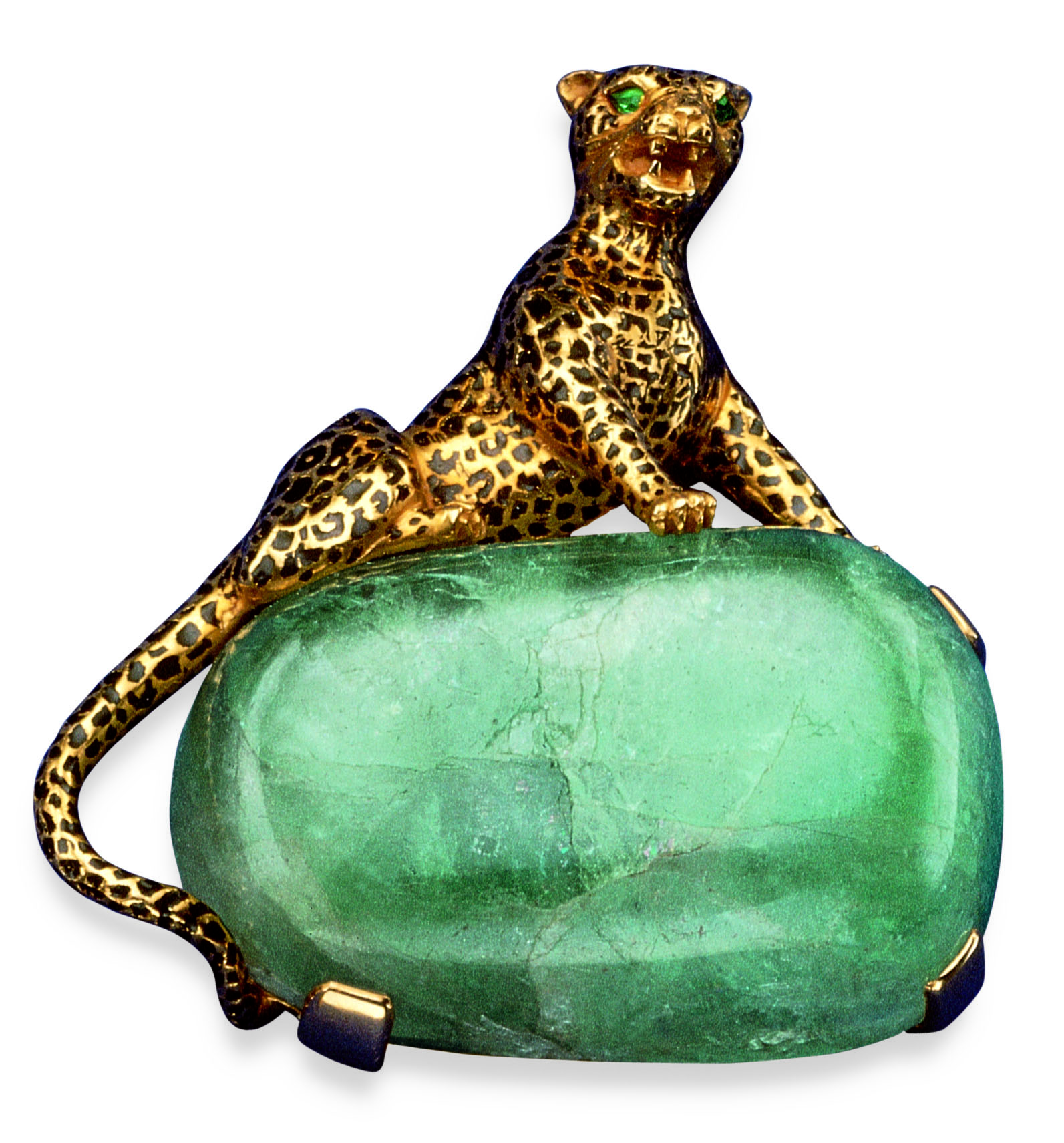
Jeanne Toussaint, designated Creative Director in 1933, took up the cat theme—launched as early as 1914 by Louis Cartier—and interpreted it as the sign of a femininity as elegant as it was free. In 1948 she supervised the making of a brooch for the duchess, featuring an emerald on which sat a sculptural panther of yellow gold with enamel spots—the first full-bodied, three-dimensional panther in Cartier history.[1]
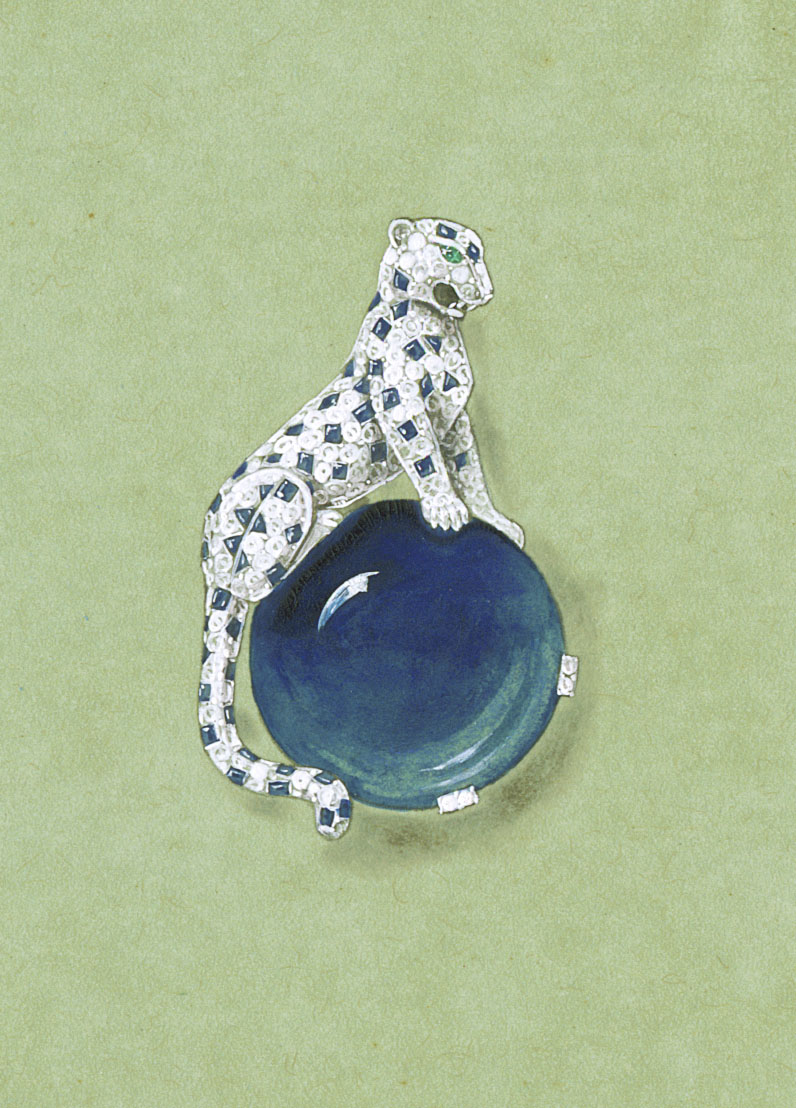
The next year Toussaint took the initiative by designing a second panther brooch , which also left its mark on jewelry history. Made of platinum, it showed a panther whose fur was composed of diamonds and sapphires, majestically perched on a sapphire cabochon weighing 152.35 carats. Toussaint was perhaps thinking of the duchess she knew so well—of her unique charm and personality—when she supervised the design and execution of this emblematic jewel. The identification seems so obvious that the brooch comes across as an alter ego. It was hardly surprising, then, that the ducal couple purchased this panther.
Wallis went on to acquire other Cartier panthers, including one stretched out along a bracelet in 1952. Many other women followed the duchess, including elegant socialites such as Daisy Fellowes, Nina Dyer, María Félix and Marella Agnelli.
The duchess and Cartier’s bestiary
While the duchess of Windsor’s image is inextricably linked to the panther, it is important to stress that she was also drawn to another big cat: the tiger. As early as 1954 she bought from Cartier a pair of gold opera glasses with a tiger handle. The tiger surfaced again two years later on a remarkably realistic bracelet. The animal’s body was fully articulated so that it could be wrapped around the wrist, while its emerald eyes and onyx spots underscored the vividness of the design. In 1969 Wallis bought a tiger brooch of similar style in order to make up a matching set.

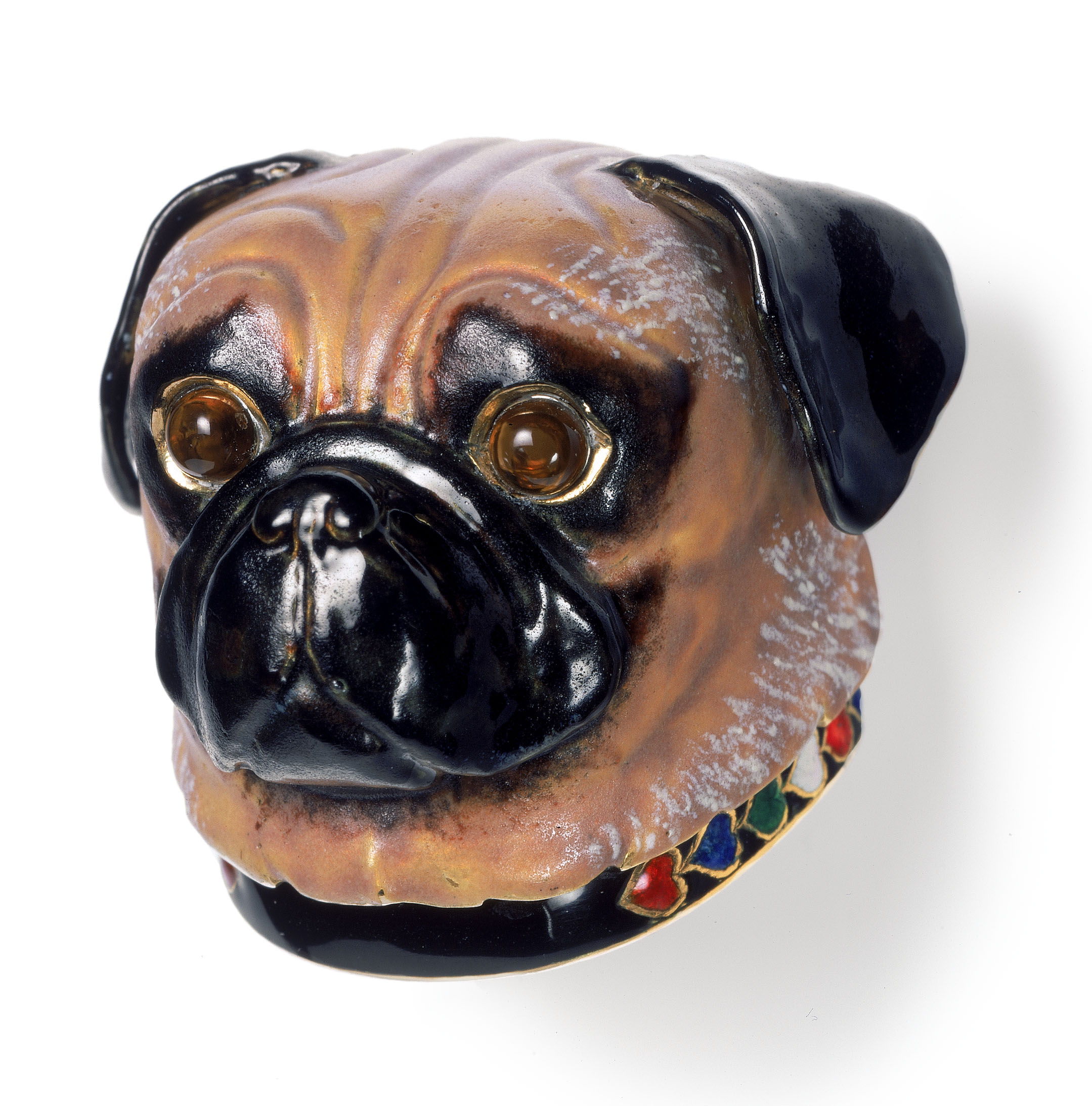
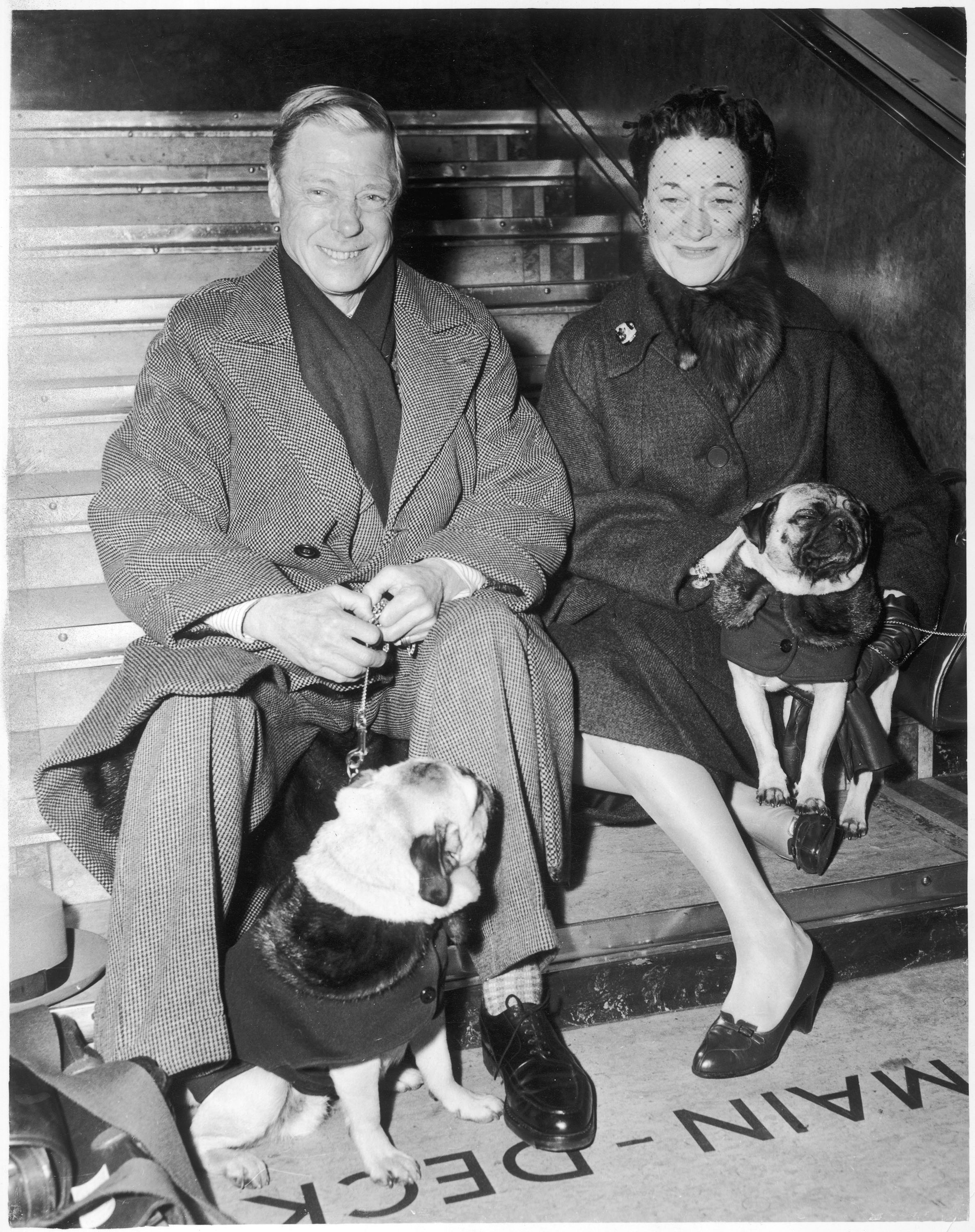
In additions to cats, other animals figured in the Duchess of Windsor’s jewelry collection. Alongside the flamingo brooch mentioned above, she notably owned adorable clip brooches of a duck and a pug, her favorite dog.
A magnificent collection
The duke’s health slowly failed over the following ten years. He died in 1972. The grief-stricken duchess, weakened, no longer left their Paris home in the Bois de Boulogne until her death in 1986.
According to her wishes, an auction of her jewelry was held the next year, with the proceeds going to the Pasteur Institute. The enthusiastic press referred to it as the most important jewelry collection of the twentieth century. Cartier was among the bidders, acquiring the flamingo brooch, which ever since has featured in the Cartier Collection alongside several other jewels that belonged to the duchess. It is regularly placed on display in leading cultural institutions around the world.
[1] Cartier had already made three-dimensional panthers, though not in full, notably for a 1935 ring showing the upper bodies of two cats holding a star ruby between their paws.