
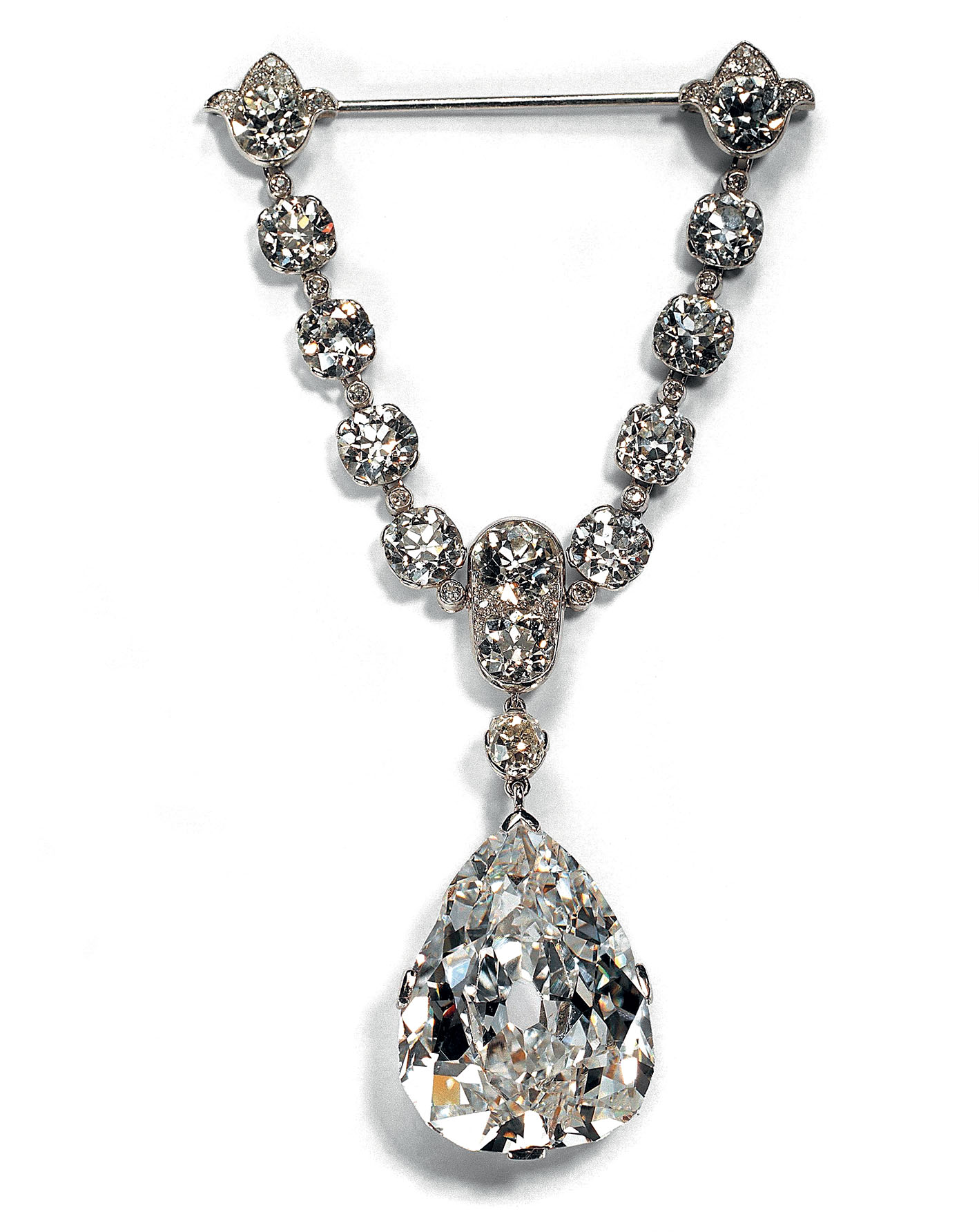
The 1869 discovery of the Star of South Africa diamond, a pear-shaped stone now weighing 47.69 carats, marked the start of mining activity in the southern tip of Africa. Consigned to Cartier in the 1910s, it was set on a pendant brooch. For the past several decades it has been part of a private collection.
Cut into a 47.69-carat pear-shaped diamond from a rough stone weighing 83.50 carats, the Star of South Africa was found on the banks of the Orange River in North Cape Province by a South African shepherd in 1869. He took it to Schalk van Niekerk, a farmer and mineral collector, who reportedly gave the man five hundred sheep, ten oxen and a horse for the diamond.
Niekerk, aware of the treasure he was holding—unlike a few years earlier, when he had let the Eureka diamond go for a paltry sum—immediately sold it to a dealer in Hopetown. Word got around, the diamond became famous, and thus the rush of diamond prospectors to South Africa began.
Sold on to Louis Hond, an Amsterdam stonecutter, the diamond was shaped halfway between an oval and a pear. The highly pure diamond was then acquired by an English aristocrat, the earl of Dudley, whose wife had it set on a brooch. In the late 1910s it fell into expert hands at the Cartier New York workshop, where it was fashioned into a pendant brooch adorned with old-cut diamonds in a muguet setting.
In 1974 the diamond reappeared on the market. Sold at auction, its new owner twice lent it to Cartier exhibitions: The Art of Cartier held at the Shanghai Museum in 2004, and Cartier and America hosted by the Museum of the Legion of Honor in San Francisco in 2009–10.