
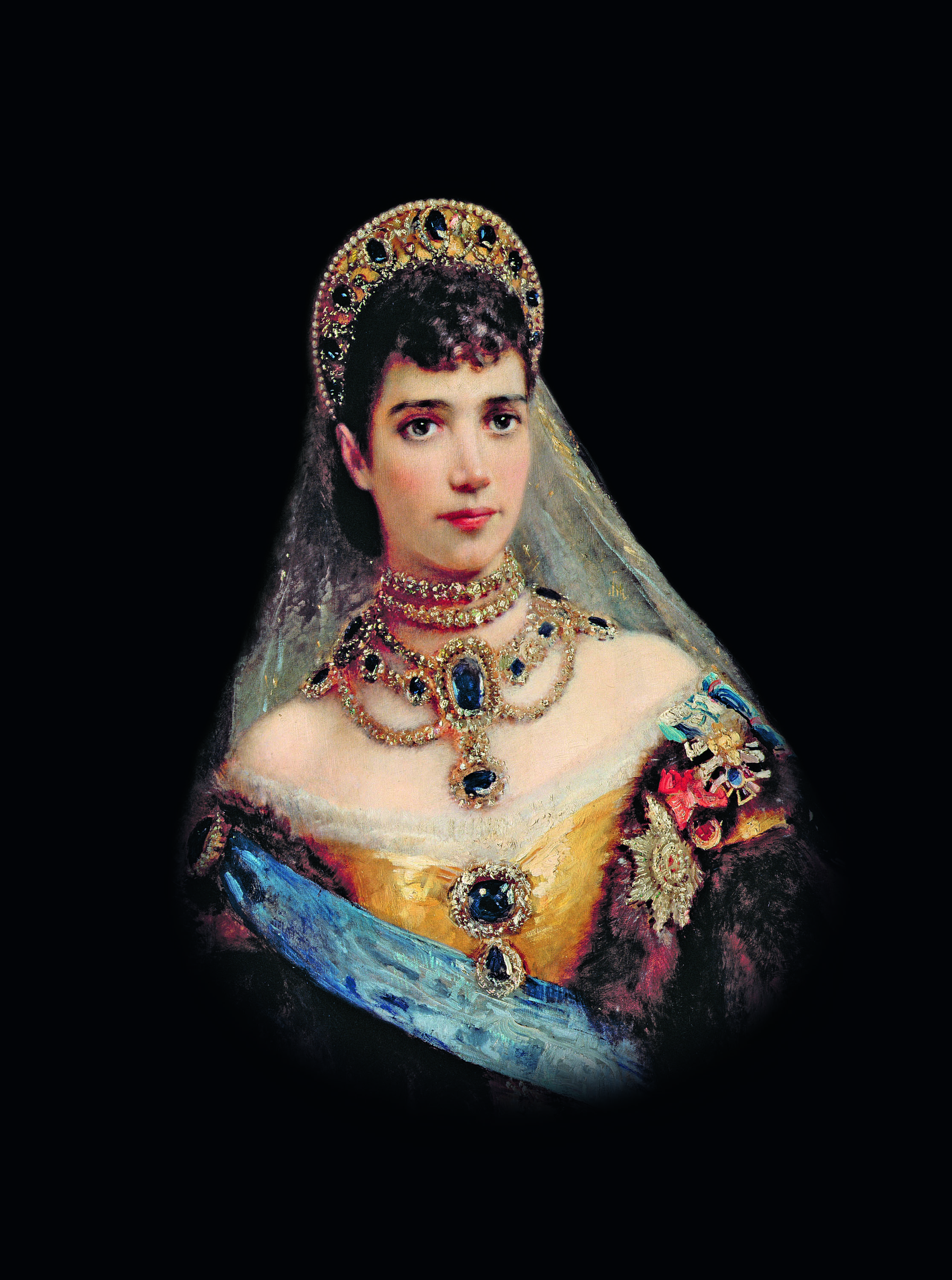
When, in 1866, Princess Dagmar of Denmark (1847–1928) married the future Czar Alexander III (1845–1894), she became Maria Feodorovna, empress of Russia. A symbol of elegance, she incarnated the lavish Russian court that sparkled with gemstones envied by jewelers the world over, such as the Romanov sapphire that Cartier was lucky enough to set first on a necklace in 1928, and again on a bracelet in 2015.
The “grandparents” of Europe
A key figure in Russian and European history in the early twentieth century, Maria Feodorovna was born Princess Dagmar of Denmark in Copenhagen’s Yellow Palace in 1847. She was the daughter of the prince and princess of Glücksburg. Her father served in the Danish military and had only a modest income. But in 1852 the family experienced its first major upheaval: the childless King Frederick VIII of Denmark (1808–1863) named Maria Feodorovna’s father, Christian (1818–1906), heir to the throne. Ten years later, things accelerated: the year 1863 was a particularly eventful one for her family. Her older sister, Alexandra (1844–1925) married Edward, prince of Wales (1841–1910, the future Edward VII), her brother Wilhelm (1863–1913) was chosen to be king of the Hellenes, and her father acceded to the Danish throne.
The rise of the Glücksburg children to the circle of the crowned heads of Europe was a deliberate strategy on the part of their mother, Louise (1817–1898). And it was efficiently carried out, since all six of her children would have a royal future, earning their parents the nickname of “the grandparents of Europe.”
For her daughter Dagmar, Queen Louise sought a high-ranking match: it would be an imperial marriage. In late 1864, it was announced that Dagmar would marry Grand Duke Nicholas (1843–1865), heir to the Russian throne. But the czarevitch fell ill and died suddenly the next year. Queen Louise and Russian Empress Maria Alexandrovna (1824–1880) nevertheless decided to pursue the union of their families by marrying Dagmar to the new czarevitch, the brother of her deceased fiancé. Dagmar thus married Grand Duke Alexander Alexandrovich during a lavish ceremony in Saint Petersburg in 1866. Following the custom of the Russian court, she converted to the Orthodox religion and changed her name, abandoning the one she was born with and adopting the name of Maria Feodorovna. The couple turned the arranged marriage into a loving one, and gave birth to six children: Nicholas (1868–1918, the future Czar Nicholas II), Alexander (1869–1870), George (1871–1899), Xenia (1875–1960), Michael (1878–1918) and Olga (1882–1960).
Maria Feodorovna, Empress of Russia
Her husband acceded to the Russian throne as Czar Alexander III in tragic circumstances in 1881, when Alexander II was assassinated. Henceforth empress of Russia, Maria Feodorovna incarnated the magnificence of the Russian court, becoming the most elegant czarina Saint Petersburg had ever seen. She chose to avoid politics, devoting herself to cultural and social life.
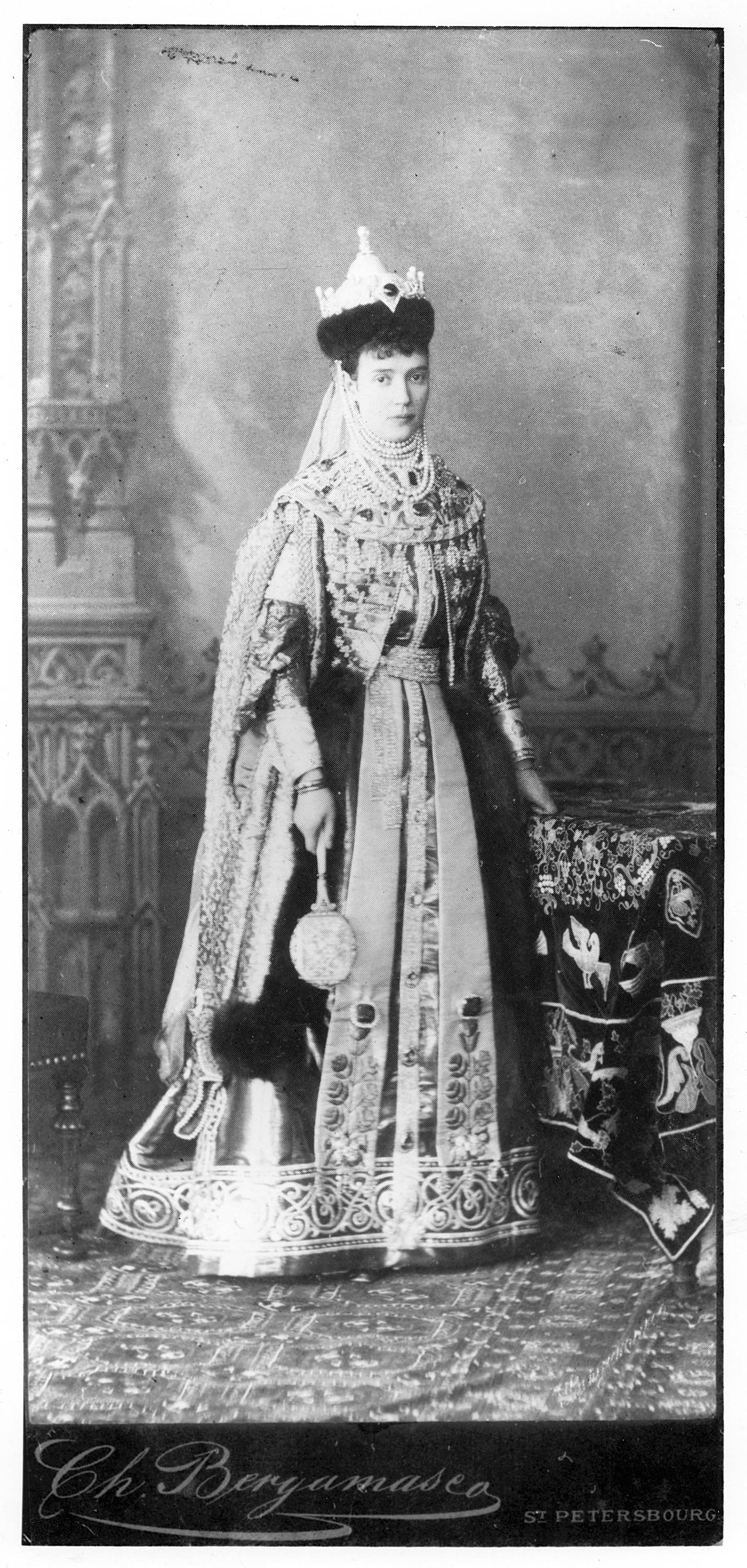
The treasures and lavishness of the Romanov court are legendary, as exemplified by a ball given on January 25, 1883 by Grand Duke Vladimir (1847–1909) in honor of Czar Alexander III, at which guests were asked to dress as Russian nobles of the sixteenth and seventeenth centuries. The empress had to live up to her reputation for elegance in order to dazzle the guests, particularly Maria Pavlovna (1854–1920), her high-society rival. She ordered a long, gem-studded brocade gown from her dressmakers; and to complete the outfit, at the bottom of the skirt, Maria Feodorovna pinned two brooches of two sapphires ringed by diamonds.
The Romanov sapphire
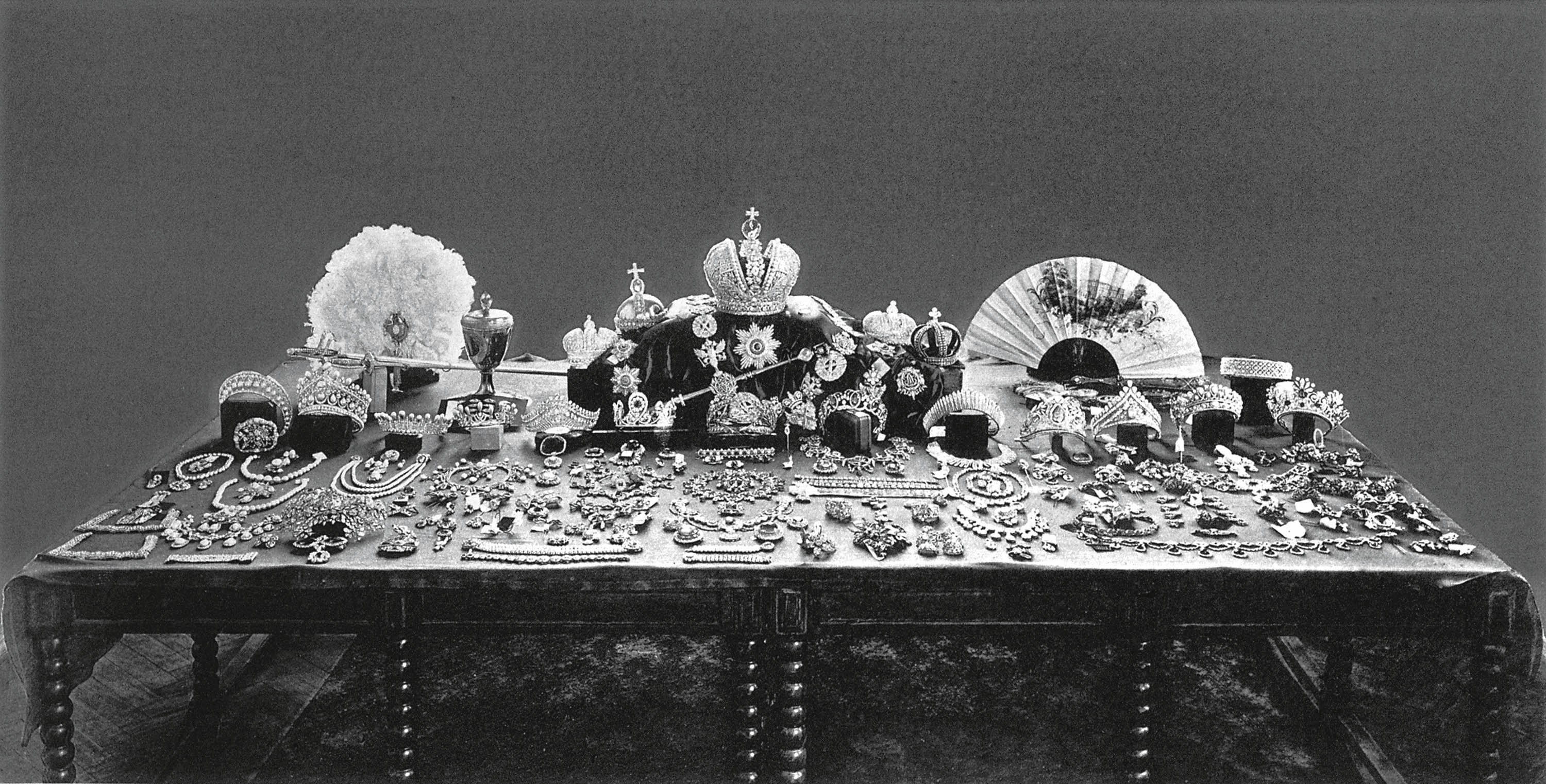
The Romanov treasure—gems, jewelry, and precious objects—was inextricably linked to the myth of imperial Russia and the fascination it sparked. In 1922 the Communist government commissioned mineralogist Alexander Yevgenyevich Fersman to draw up an inventory of the crown treasures.
A work of nearly three years that will lead to the publication of the catalog Russia’s Treasure of Diamonds and Precious Stones which Cartier also has a copy still today.
One of the sapphires that adorned the dress of Maria Feodorovna during the famous ball of 1883 is listed there.
The stone surfaced again in Cartier New York in 1928. The following year, singer Ganna Walska (1887–1984) fell in love with the Russian sapphire, which she wore on different necklaces until 1970, the year her collection of jewelry was auctioned. The Romanov sapphire reappeared at auction in 1992, and many years later—in 2014 to be precise—it adorned a bracelet designed and displayed by Cartier.

Dowager empress
Czar Alexander III died of an illness in 1894. His son became Nicholas II and married Princess Alix of Hesse, who took the name Alexandra Feodorovna but did not enjoy the favors of her mother-in-law, henceforth dowager empress.
Maria Feodorovna devoted all her time to charitable work, crisscrossing Europe and visiting her family in the royal courts of Denmark, Britain and Greece. She also traveled to France, notably Biarritz on the Basque coast, which she particularly liked. Photos taken of the dowager empress in 1907 show her on the balcony of a villa dubbed Les Vagues (The Waves).
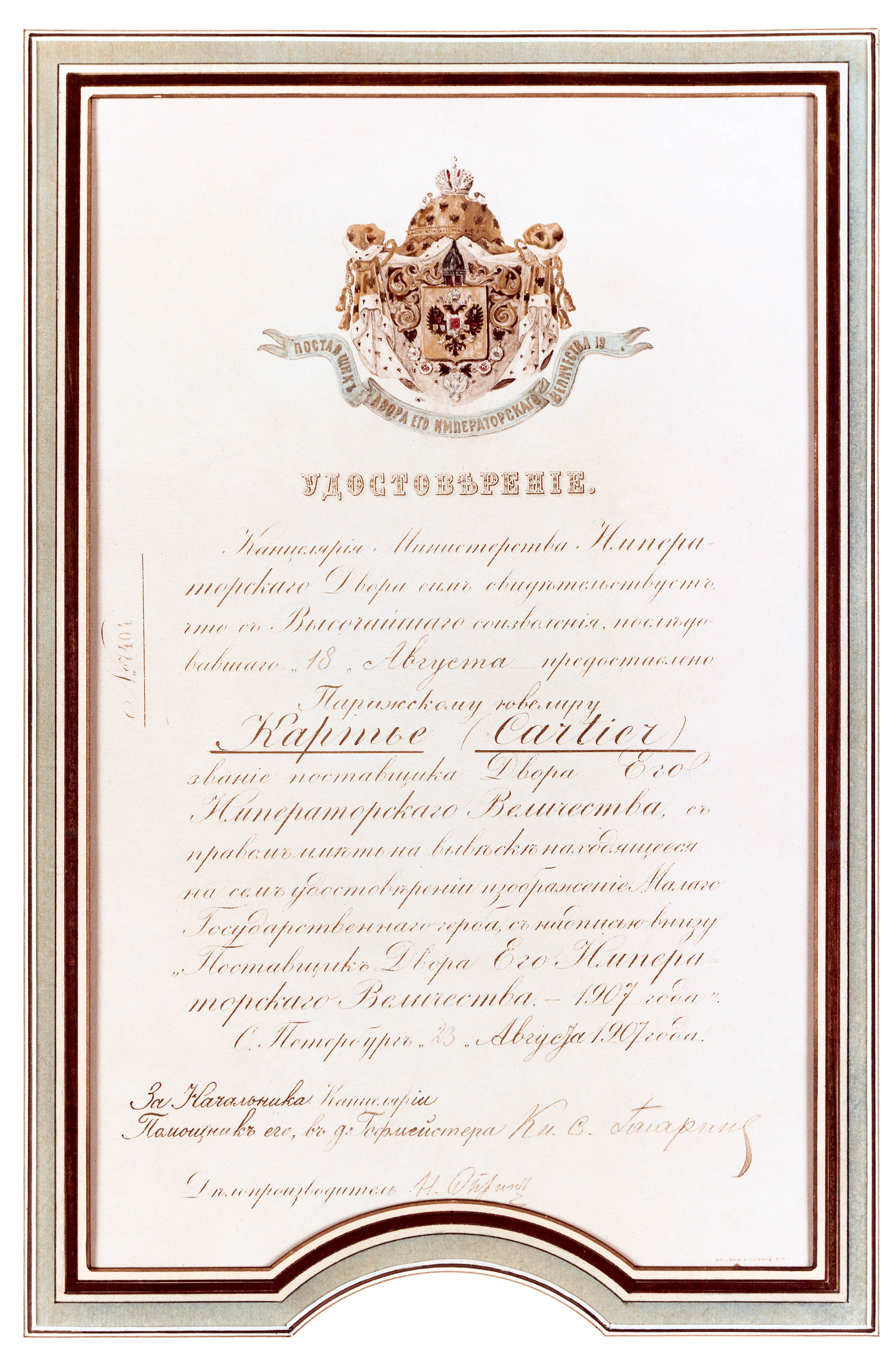
In that same year, and that same city, Maria Feodorovna’s name is found in Cartier’s client ledger. Her purchases in 1907 were two tie pins and two hard-stone rabbits. At that time hard stones sculpted into animals or flowers were wildly popular, inspired by the work of the Russian goldsmith Fabergé. On returning to Russia, Maria Feodorovna pressed her son, Czar Nicholas II, to grant Cartier a warrant as official supplier. The jeweler received the warrant that same year.
Exile
During World War I, Maria Feodorovna visited the bedsides of the wounded in hospitals, and became involved in the Russian Red Cross. She saw her son, Czar Nicholas II, early in 1917, but it would be the last time before he abdicated. Seventy years old when the Russian Revolution erupted, the dowager empress refused to leave Russia and sought refuge in the Crimea, where she was joined by some of her family and friends (Grand Duke Alexander and Grand Duchess Xenia and their six children, Prince Yusupov and his parents and wife, Grand Duchess Irina, and Grand Duchess Olga and her husband).
Only in 1919 did Maria Feodorovna leave Russia. She boarded HMS Marlborough and sailed for England, where she was housed by her sister, Queen Alexandra. Yet she soon decided to return to her home country, Denmark. There Maria Feodorovna, once czarina with all the gold and pomp of the Russian court, died on October 13, 1928. Around her had swirled the men, women, stories and gemstones that would mark the history of the Maison of Cartier.