
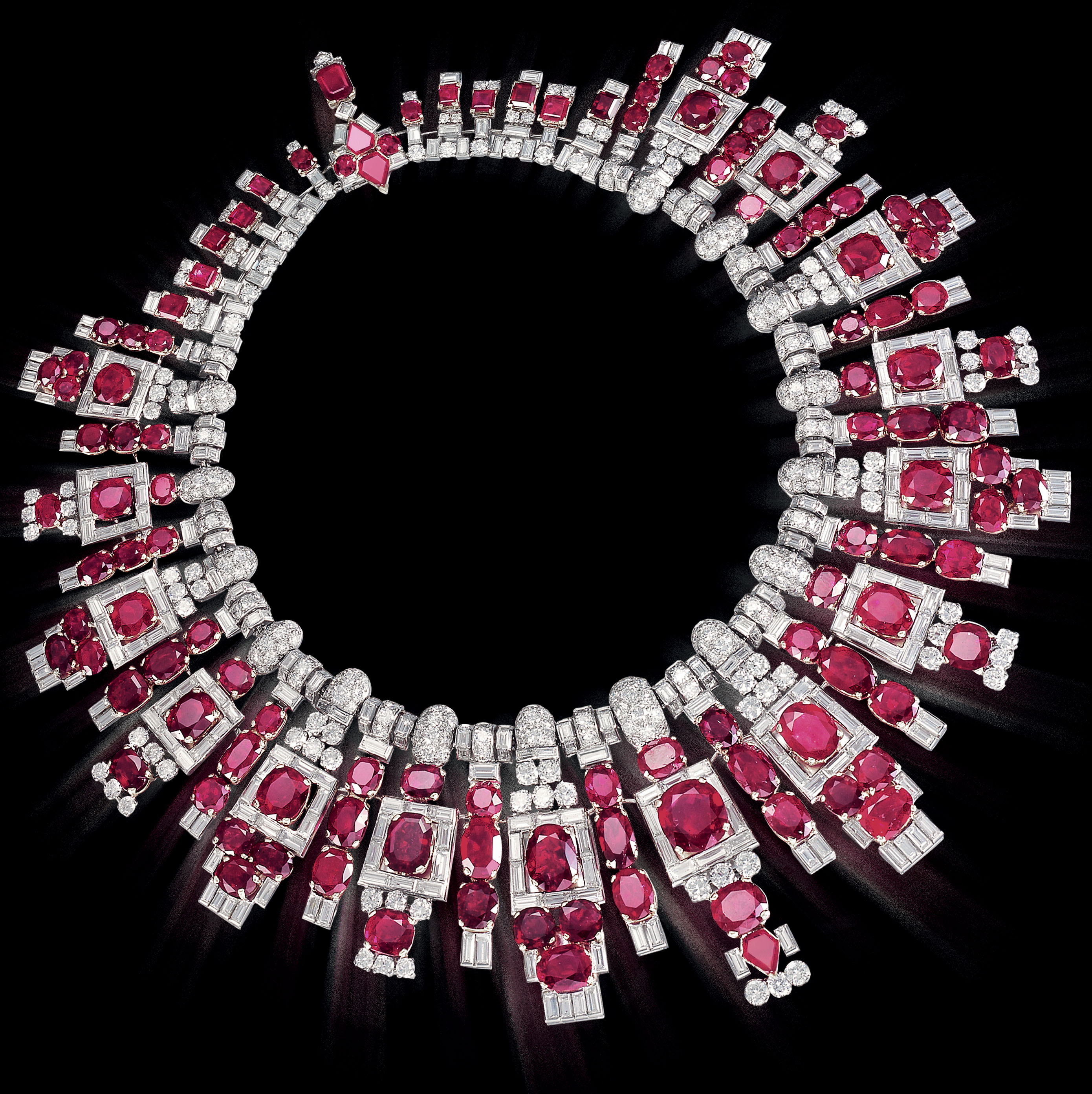
The 119 rubies of the Nawanagar necklace all come from highly reputed Burmese mines, constituting an extraordinary piece of jewelry, made by Cartier in 1937 for the Maharajah of Nawanagar.
Jacques Cartier, youngest of the three Cartier brothers and head of the London branch, went to India for the first time in 1911. During subsequent trips he developed relationships of trust and friendship with local monarchs, including Ranjitsinhji Vibhaji of Nawanagar, a great collector of gemstones as well as the uncle and adoptive father of the Maharajah Jam Saheb Digvijaysinhji of Nawanagar.
It was the latter who came to Cartier in 1937 with his finest rubies from Burma—119 in number, totaling approximately 210 carats—and asked the jeweler to design a necklace around them. Cartier devised an Art-Deco style necklace that combined the fiery stones with numerous baguette- and brilliant-cut diamonds. The modernity of this piece of jewelry, playing on the geometric shapes of the stones, was striking.
It changed hands several times and underwent alterations. In the 1960s, the piece came back to Cartier, where its size was reduced and it was converted into a woman’s necklace.
The Maison acquired it once again in 2004. The necklace was entirely restored to its original state, thanks to Cartier archives, except that the more recent size was retained as being better suited to a woman’s body.