
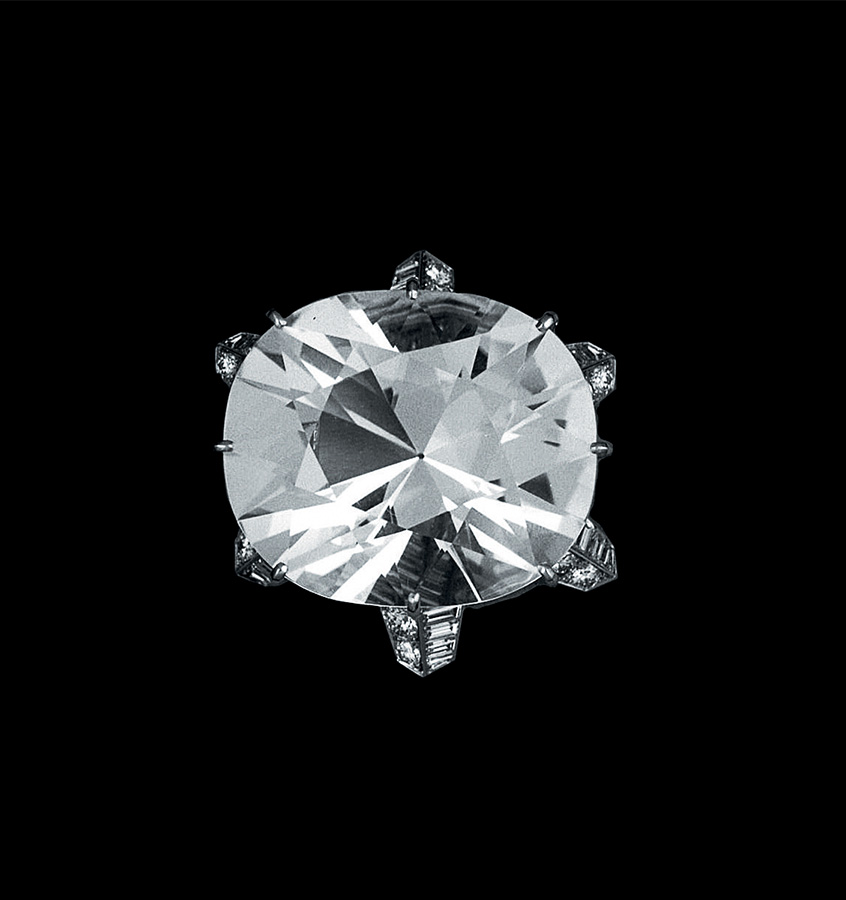
Found in the South African mine of Jagersfontein in 1895, the Jubilee diamond is a colorless gem of exceptional clarity and purity, weighing 245.35 carats. Cut into an 88-facet shape that combined the rose and brilliant cuts, the Jubilee gave its name to this new cut.
In 1895, a colossal rough diamond weighing 650.80 carats was taken from the Jagersfontein mine in South Africa. It was sold to a consortium of London dealers who sent it to Amsterdam to be cut. The most experienced stonecutters got down to work, fashioning two extraordinary diamonds from the raw material. One, a pear-shaped diamond weighing 13.34 carats, was bought by King Charles I of Portugal for his wife; the other, weighing 245.35 carats, was the product of a new, 88-facet approach that combined the rose cut and brilliant cut, resulting in a modern, sophisticated stone. This was in 1897, when Queen Victoria was celebrating the sixtieth year of her reign, or diamond jubilee. The new cut—like the new diamond—was therefore naturally christened “jubilee.”
The Jubilee diamond was one of the attractions of the Universal Exposition hosted by Paris in 1900. Shortly afterward, Indian industrialist Sir Dorabji Tata bought it and had it set on a white heron-feather aigrette for a turban. In 1935, three years after Tata died, his heirs asked Cartier London to sell it. In December of that year Cartier organized a major exhibition of historic diamonds in Paris, and included the Jubilee. In 1938, Paul-Louis Weiller, a loyal Cartier client as well as industrialist and art patron, had it transformed into a very modern brooch: it was placed in a six-branched star set with baguette-cut diamonds. The new owner subsequently lent it to several exhibitions, notably in 1960 at the Smithsonian Institution in Washington, D.C., and in Geneva. In 1966 the Jubilee diamond returned to South Africa, where it was displayed in Johannesburg.
Today the Jubilee diamond belongs to a private collector.