
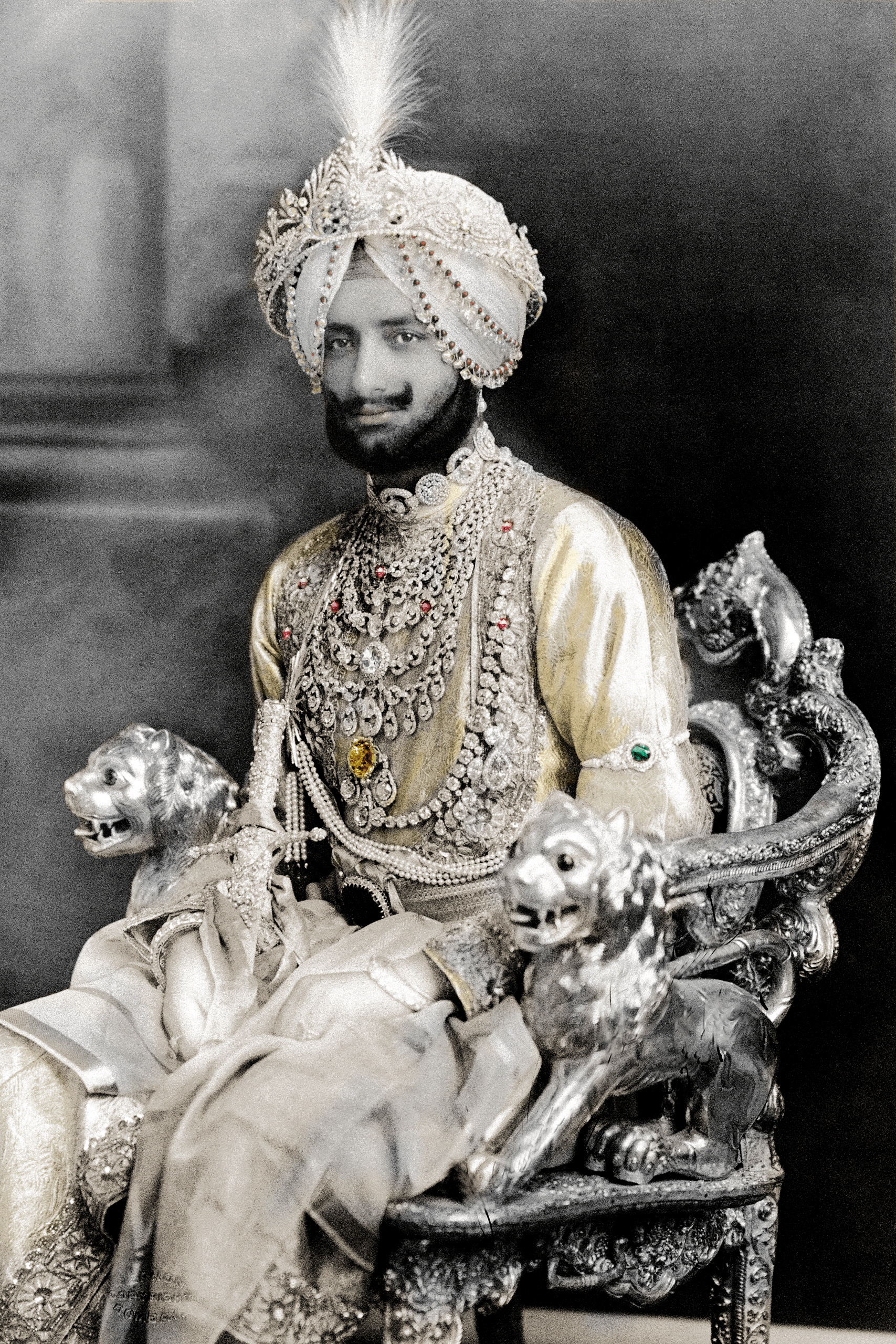
Found in 1888 in one of the four Kimberly mines in South Africa, the De Beers is a cushion-shaped yellow diamond weighing 234.65 carats. Having belonged to the dynasty of the maharajahs of Patiala, it was the major feature of a ceremonial bib necklace made by Cartier in 1928.
In March 1888, a yellow diamond weighing 439.86 carats was found near Kimberly, South Africa. Named after the mine where it was discovered, the De Beers lost a little over 200 carats when cut into a cushion shape, but it gained in purity and brilliance. At the time, its 234.65 carats made it one of the largest cut diamonds in the world. It was featured at the Universal Exposition held in Paris in 1889, and the following year was bought by Rajinder Singh, maharajah of Patiala. In the late 1920s, his son, Sir Bhupindra Singh, consigned thousands of gemstones to Cartier Paris to create Indian finery in a Western style. Those stones included the De Beers diamond. In the expert hands of Cartier’s artisans, it became the highlight of a ceremonial bib necklace composed of 2,930 diamonds and two large Burmese rubies. Before delivering it to Patiala, in 1928 Cartier exhibited the necklace in its Rue de la Paix showroom alongside other major pieces designed for the maharajah.
In 1982 the diamond came up for auction in Geneva but did not meet its reserve price. Meanwhile, a few other vestiges of the necklace surfaced in an auction in London in 1998, although lacking the finest stones. The Cartier Collection decided to buy them all, in order to restore and reconstitute the original bib necklace. Cartier replaced the missing gems by synthetic stones, in the hope of someday finding the originals.