
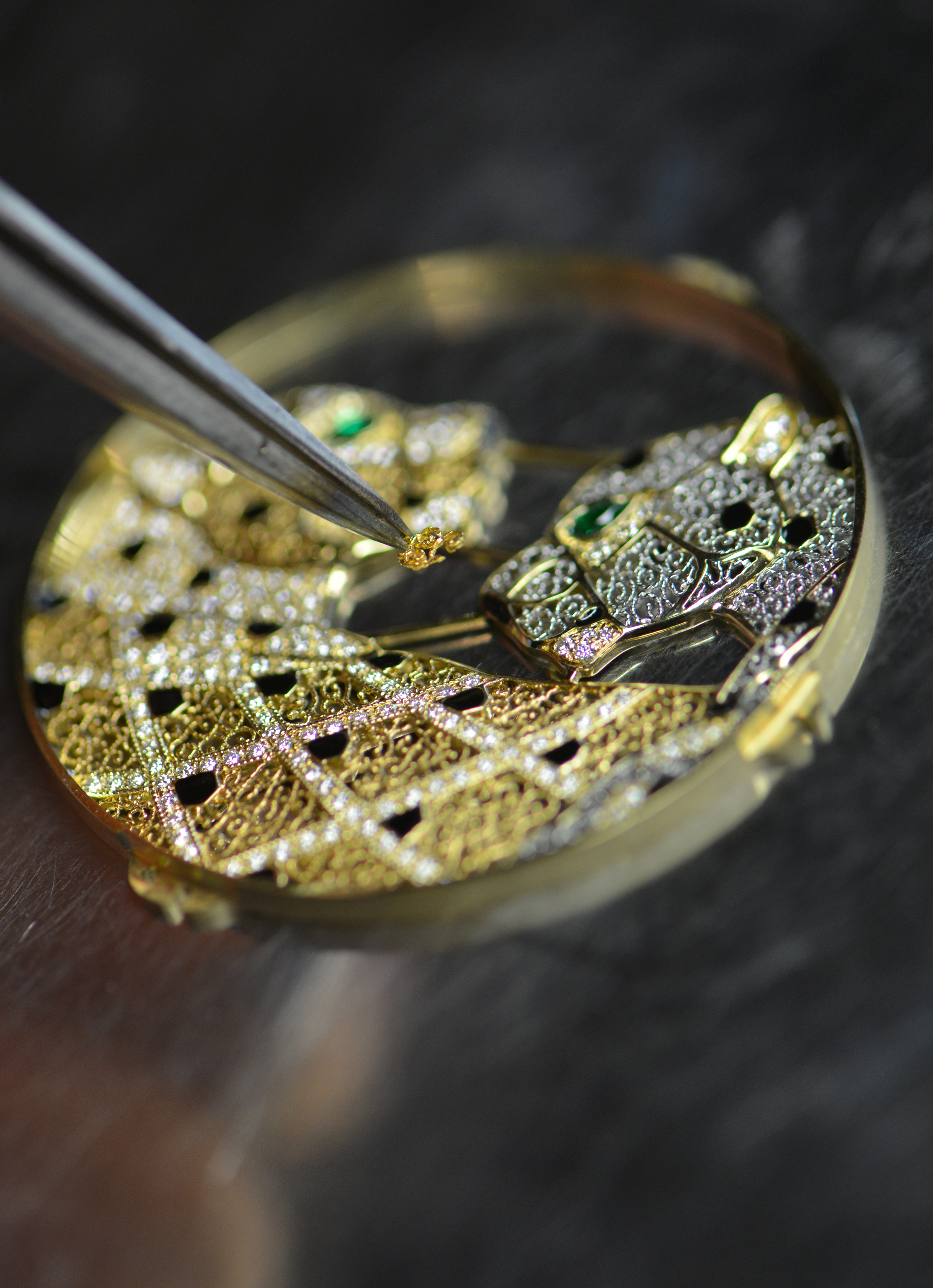

Filigree is the delicate art of creating patterns through the work of precious metal wires twisted, intertwined and welded on a piece of metal.This traditional craft, which dates back to Antiquity, is still being perpetuated in Cartier’s Maison des Métiers d’Art (House of Craftsmanship), where it is being reinvented to suit the realm and scale of jewelry timepieces.
Filigree emerged in Mesopotamia and Egypt in earliest Antiquity. This precious metalworking technique created patterns from tiny balls of gold, silver or copper that were stuck together and then drawn into wire through a plate with holes of decreasing diameter, until the desired width was achieved. The wire would then be woven into a delicate pattern and soldered onto a backing. This technique spread to the Mediterranean and then into Asia, later earning its title of nobility in Portugal. At its height, filigree work was used to decorate precious sacred and secular objects, armor and garment trimmings, until it began to fall out of fashion from the eighteenth century onward.
By incorporating filigree into the skills perpetuated at its Maison des Métiers d’Art, Cartier is helping to preserve an age-old craft heritage, alongside granulation and enameling.
In the 2010s the challenge was to adapt filigree work to the smaller scale of watch cases. Cartier artisans worked extremely fine gold and platinum wires using tools specially designed for the occasion. Twisted, laminated, rolled and cut into small rings, these wires were assembled in the “openwork” filigree method, being attached to one another but not to a metal backing. In 2015, a watch depicting a pair of panthers was designed around this technique thanks to the combined arts of filigree, lacquer work, and stone setting.