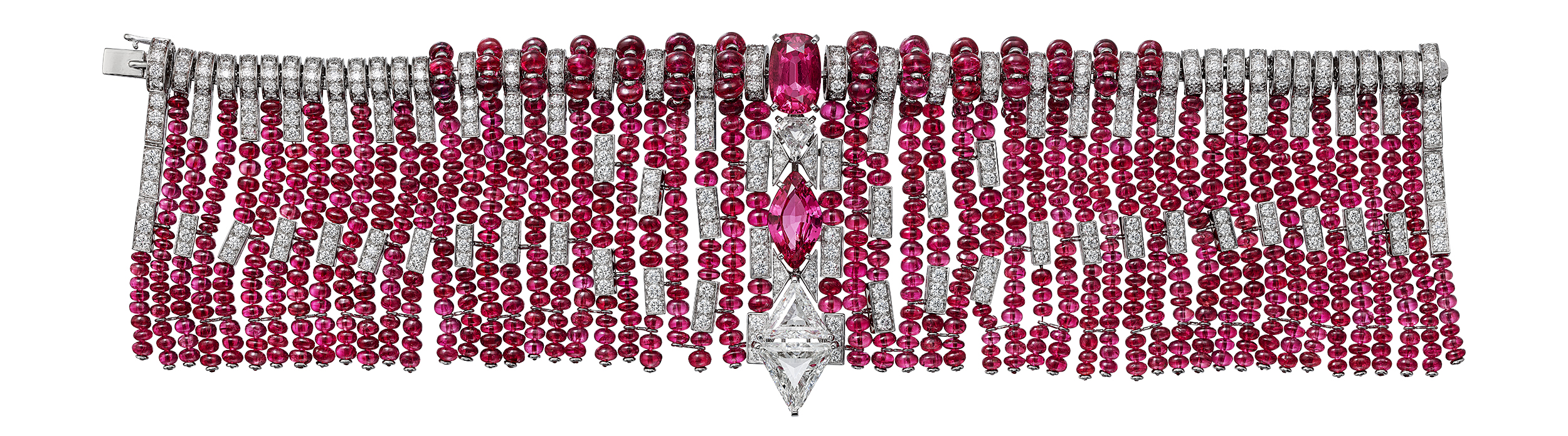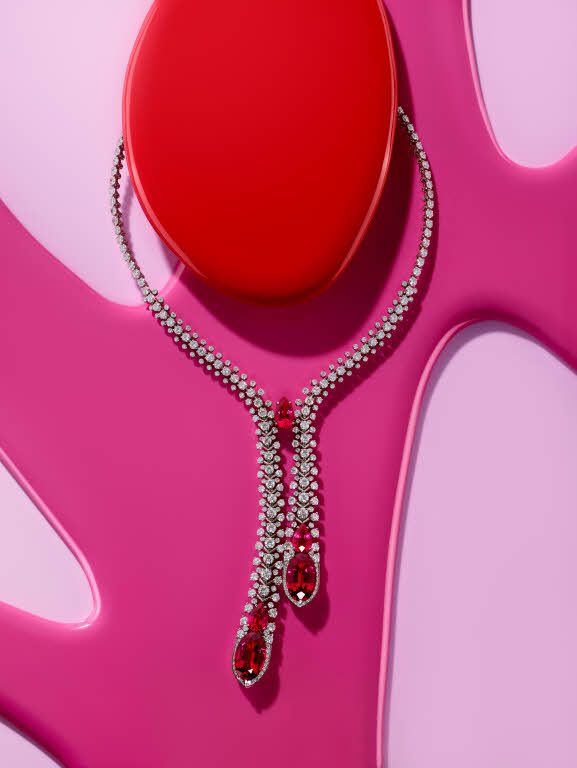
Spinel is a gemstone that comes mainly in red or pink and was historically confused with ruby. Nowadays it is appreciated for its own qualities, with contemporary designs regularly highlighting spinel.
- Group: spinel
- Chemical composition: aluminum and magnesium oxide
- Colors: red, pink, yellow, green, blue, purple, brown or black
- Hardness: 7.5-8 (Mohs scale)
- Main sources: Burma (Myanmar), Ceylon (Sri Lanka), Tajikistan, Vietnam, Tanzania, Madagascar, Brazil, Australia
Etymology, history and legends
It is uncertain where the name “spinel” originated. It might be derived from the Latin spiculum, “spear,” or from the Italian spinella, meaning “thorn” (because the raw crystals have such sharp points) or from the Greek word spinther – “spark”—because of its intense brilliance.
The history of spinels has rather merged with that of other red gemstones, chiefly rubies. In India, spinels were also confused with red diamonds, which carried their own symbolism because each color was related to a specific social caste. Yellow diamonds were reserved for merchants; black diamonds—most likely magnetite or octahedral black spinel—were for servants; and red diamonds were for warriors. But red diamonds were still unknown in India at that time, so the reference must be to spinels gathered in the sands of the Penner River, north of Chennai (formerly Madras).
The 10th-century Arab traveler Mohamed Ben Mansur, Albert the Great (c. 1200–1280) and Marco Polo (1254–1324) all mentioned ruby-like red stones found in the historical Badakhshan region (today’s northeastern Afghanistan and eastern Tadjikistan). They were named lal-bedaschan in Arabic, ballagius in Latin, ballas in German, and balais in French, with the name rubis balai historically meaning spinels.
Most big red stones that adorn illustrious crowns and jewelry are spinels. The famous Black Prince’s Ruby—a stone of some 2 inches across that first came to light in the 14th century—is set into the Imperial State Crown of British royalty. The Tribute to the World, also known as the Timur ruby, is a polished 361-carat spinel set into one of Queen Victoria’s necklaces and has the names of six previous owners engraved onto it. The French Crown Jewels boast the Côte-de-Bretagne, a 105-carat red spinel on display in the Louvre museum’s Apollo Gallery. Russia’s Great Imperial Crown, which can be seen at the Kremlin Armory in Moscow, is decorated with an enormous spinel weighing almost 399 carats. And the Iranian Crown Jewels collection is said to contain the world’s most beautiful ancient spinels.
Colors, cuts and shapes
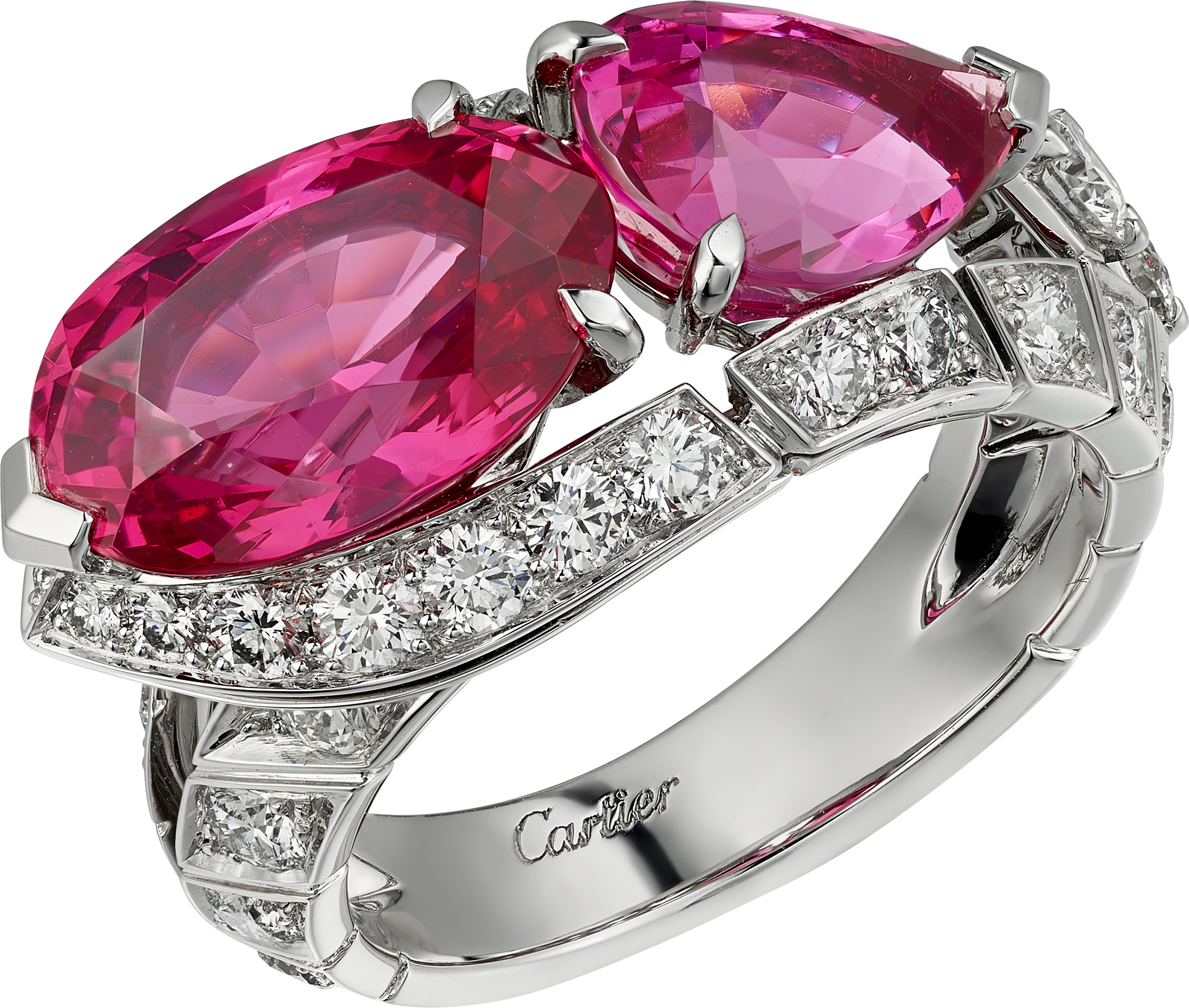
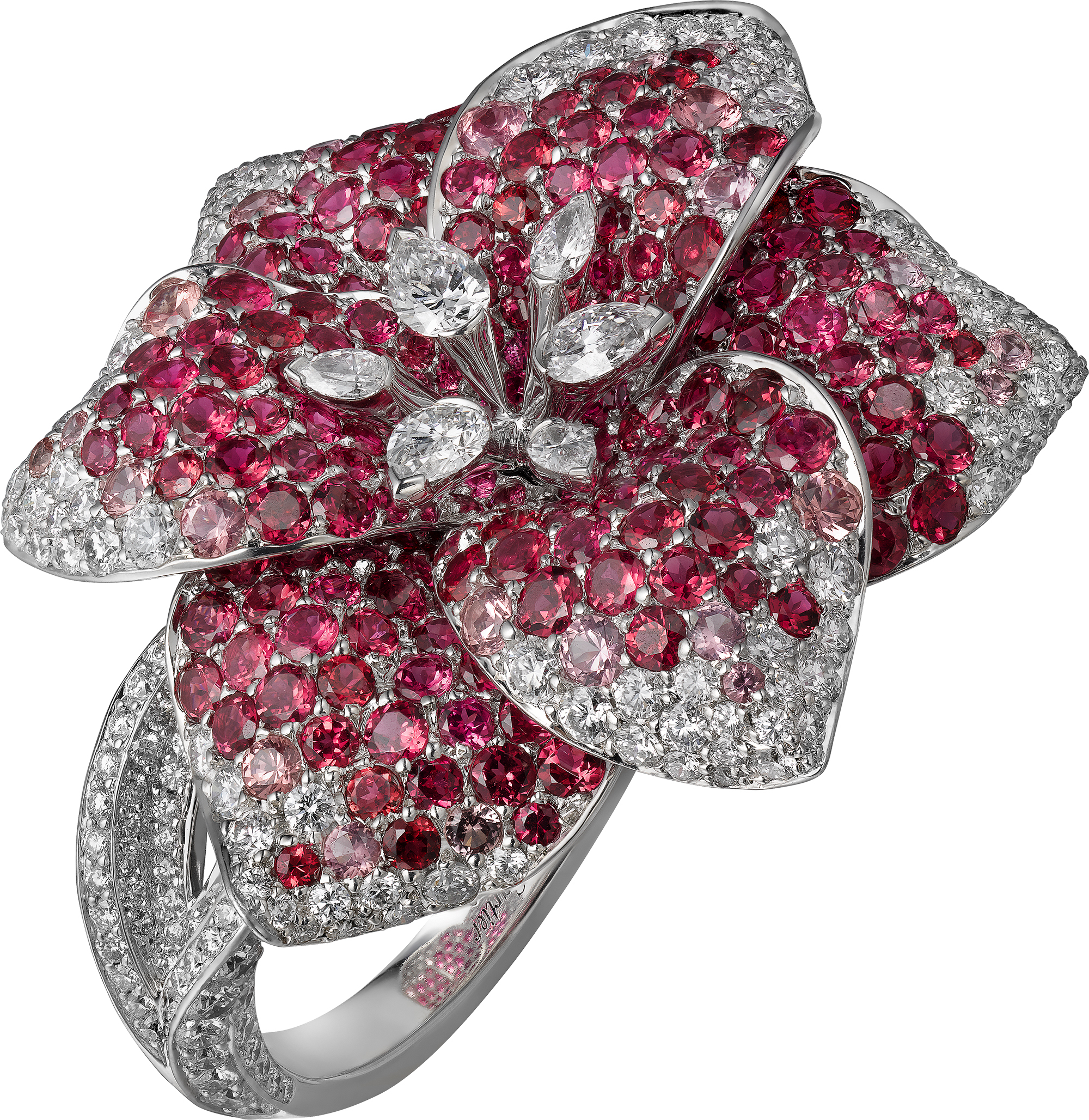
Spinel comes in all colors. Mostly it is red or pink, but also blue, purple, violet and even – quite rarely—green. Only recently have purple, lavender, gray and black spinels begun to be used.
The stones’ hue will depend on their chemical nature. Red and pink spinels get their color from small traces of chromium—in the order of one percent—replacing aluminum. Iron gives a light blue color to the stones and also, when it displaces magnesium, gives rise to black spinels.
Red spinel can be distinguished from ruby by its slightly orangey hue, which shows up more noticeably when you place the two gems side by side. Although not as rare as ruby, red spinel is still highly regarded by experts and in today’s market it commands a significant price.
Formation of the stone
Spinel is characterized by a very fine crystallization and flawless clarity. It is formed by magnesium-rich molten limestone or dolomites coming into contact with rocks poor in silica but rich in aluminum, and often occurs in the same places as ruby and sapphire. Spinel is a mineral of high hardness (8), with good resistance to abrasion, water and impact.
Origins
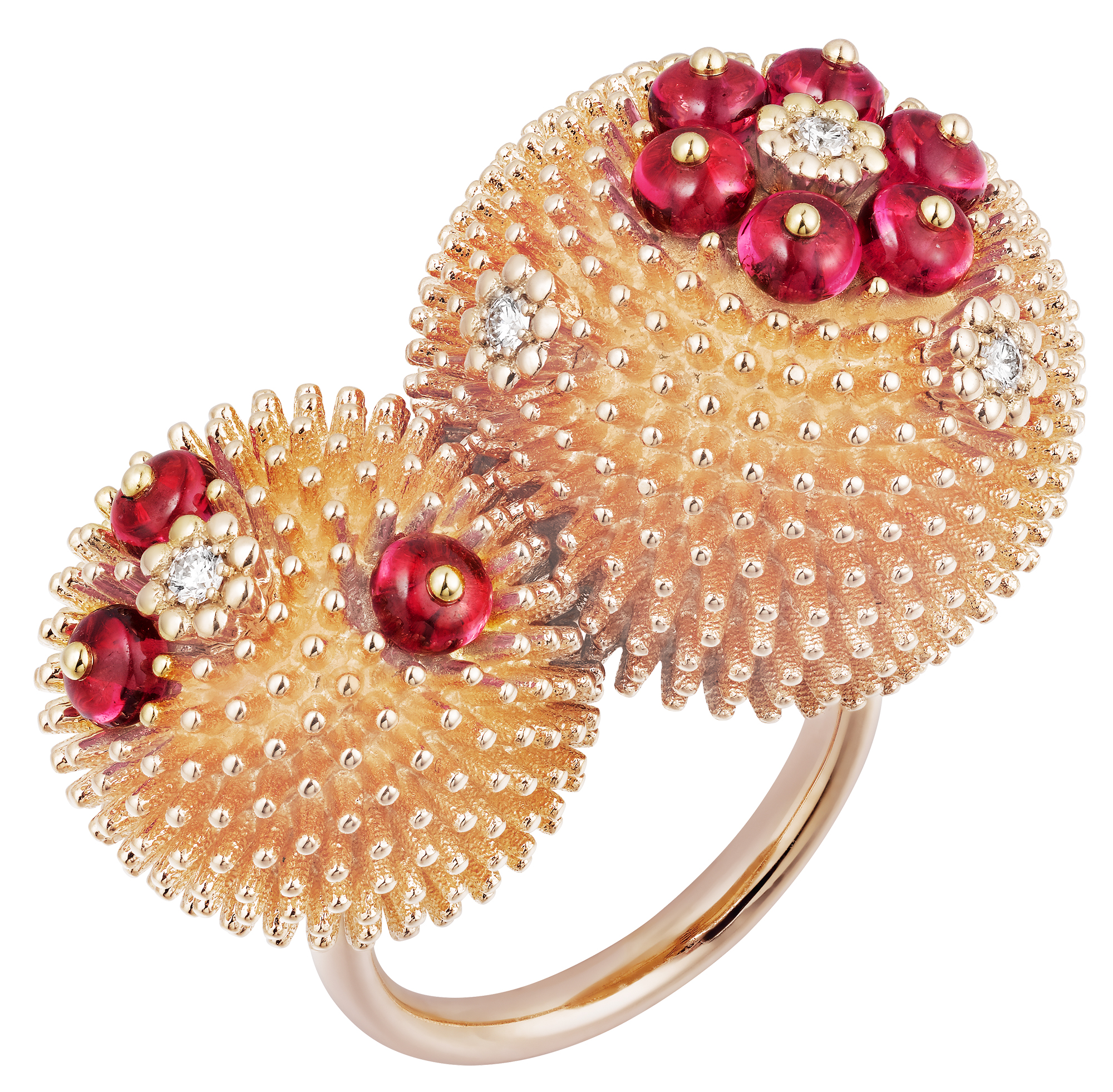
Spinel has been mined from the legendary seams of Badakhshan, in the ancient mines of Ceylon (Sri Lanka) and Burma (Myanmar), and more recently, new mining sites have sprung up in Tanzania, Madagascar and Vietnam.
Tajikistan: It is acknowledged that history’s great red spinels—long thought to be rubies—originated in the Badakhshan in the south of what is today called Tajikistan. These stones may have been mined at the Kuh-i-Lal mine on the Afghan border, which yielded very fine pinkish red and pink spinels until recently. They are often referred to as “Pamir spinels” after the mountains they come from. The mine is currently more or less inactive.
Burma: The Mogok deposits in Burma are rich in intense red spinels of very fine quality. They differ from those at the Mang Sing mine, discovered in the 2000s, which are pinker in hue and have a different crystallization. Burmese stones also occur in shades of orange, violet or lavender, blue-green and gray, mostly in pastel tones.
Ceylon: In Sri Lanka (formerly Ceylon) the gem-rich sands of the rivers offer up stones in the whole spectrum of colors, often in light, clear hues. There are also very fine cobalt-blue spinels, along with stones with changing colors.
Vietnam: Spinels from Vietnam are on the pink-to-purple gradient, or else light or royal blue. The stones are on the small side, but of high quality.
Tanzania: The most impressive deposits to be mined in the early 21st century are in Tanzania, where stones range from pink to red, sometimes even shading into purple. Blue to purple spinels are also found. Tanzanian mines can supply substantially sized gems of high quality—as an example, in 2007 a 114-lb crystal was found and cut into many gemstones.
Tanzanian spinels are highly prized for their reddish-pink hues, which are both deep and bright, unlike the stones from Asia.
Kenya, Laos, Madagascar, India and Pakistan are also well-known for producing spinels, in shades tending toward pastel.
Certification
It is not always possible to determine the origin of spinels.
A stone’s origin does not guarantee the quality of the gem, although it is a recognized criterion in determining its value.
The indications of color by origin are based on professional assessments and on conclusions drawn from examining most fine quality stones of this provenance.
It is customary to indicate provenance by country on gemological certificates. The name of the deposit is rarely mentioned.
Care recommendations
Although spinel is a stone of high hardness, it must be handled with care to ensure it does not suffer any hard knocks.