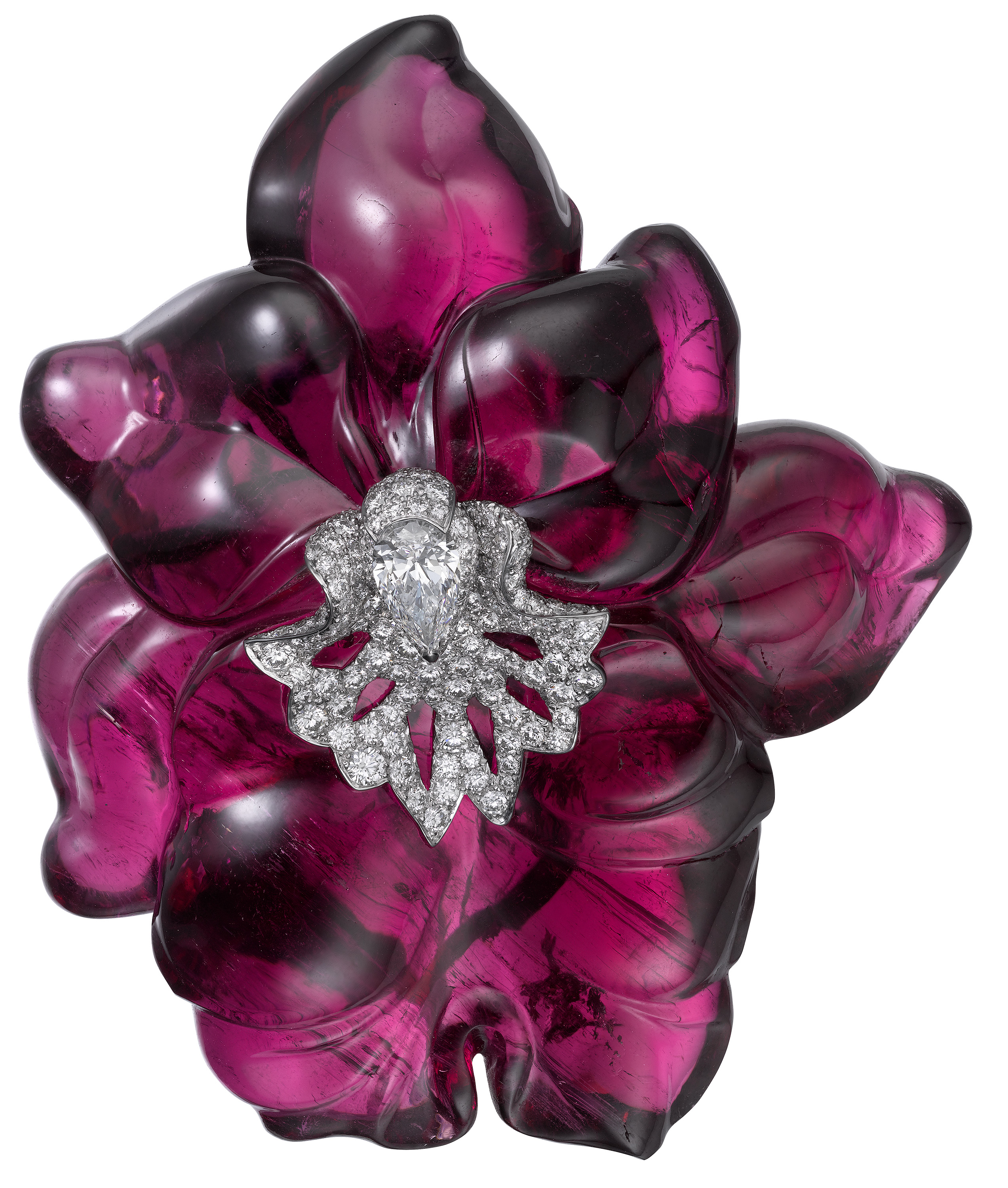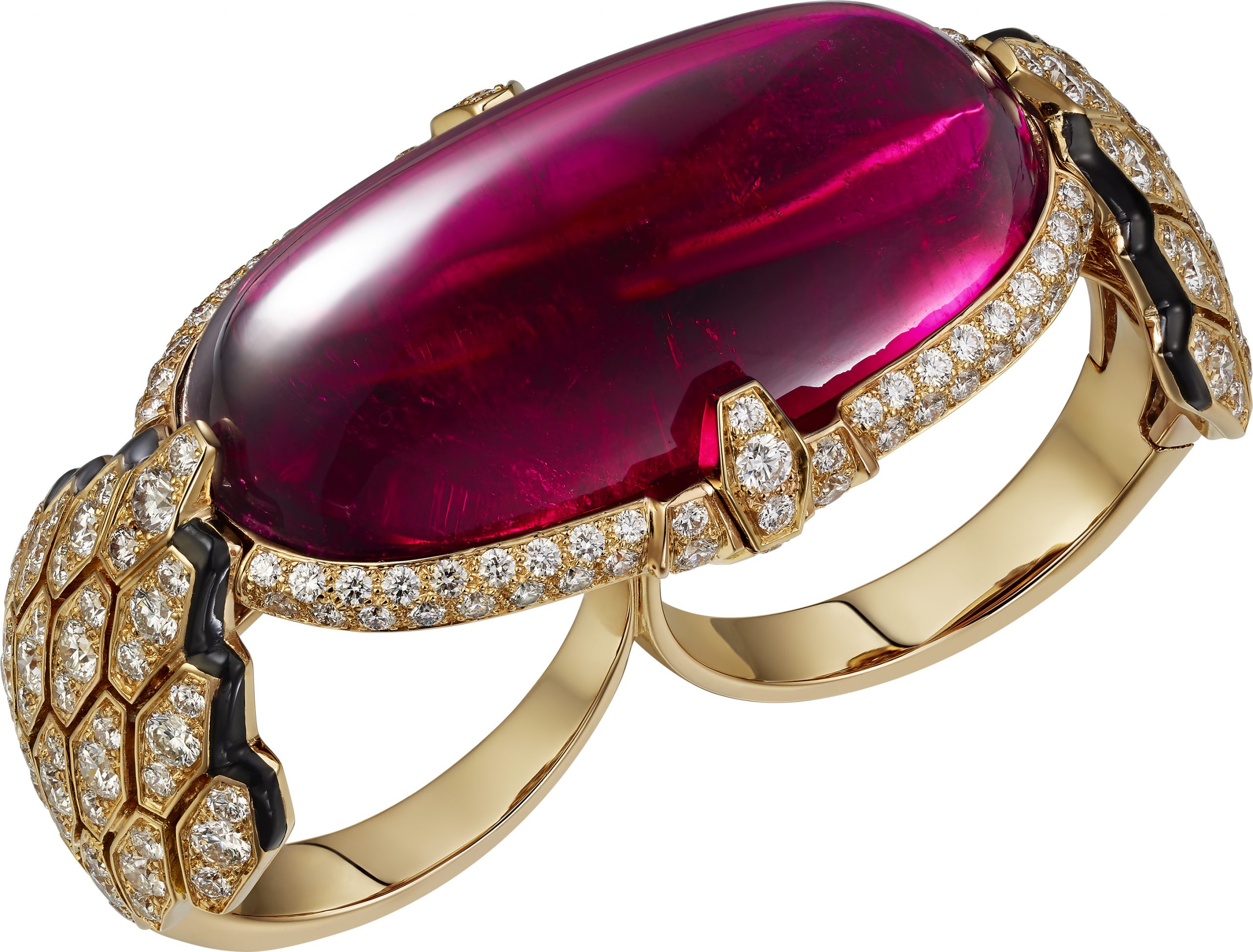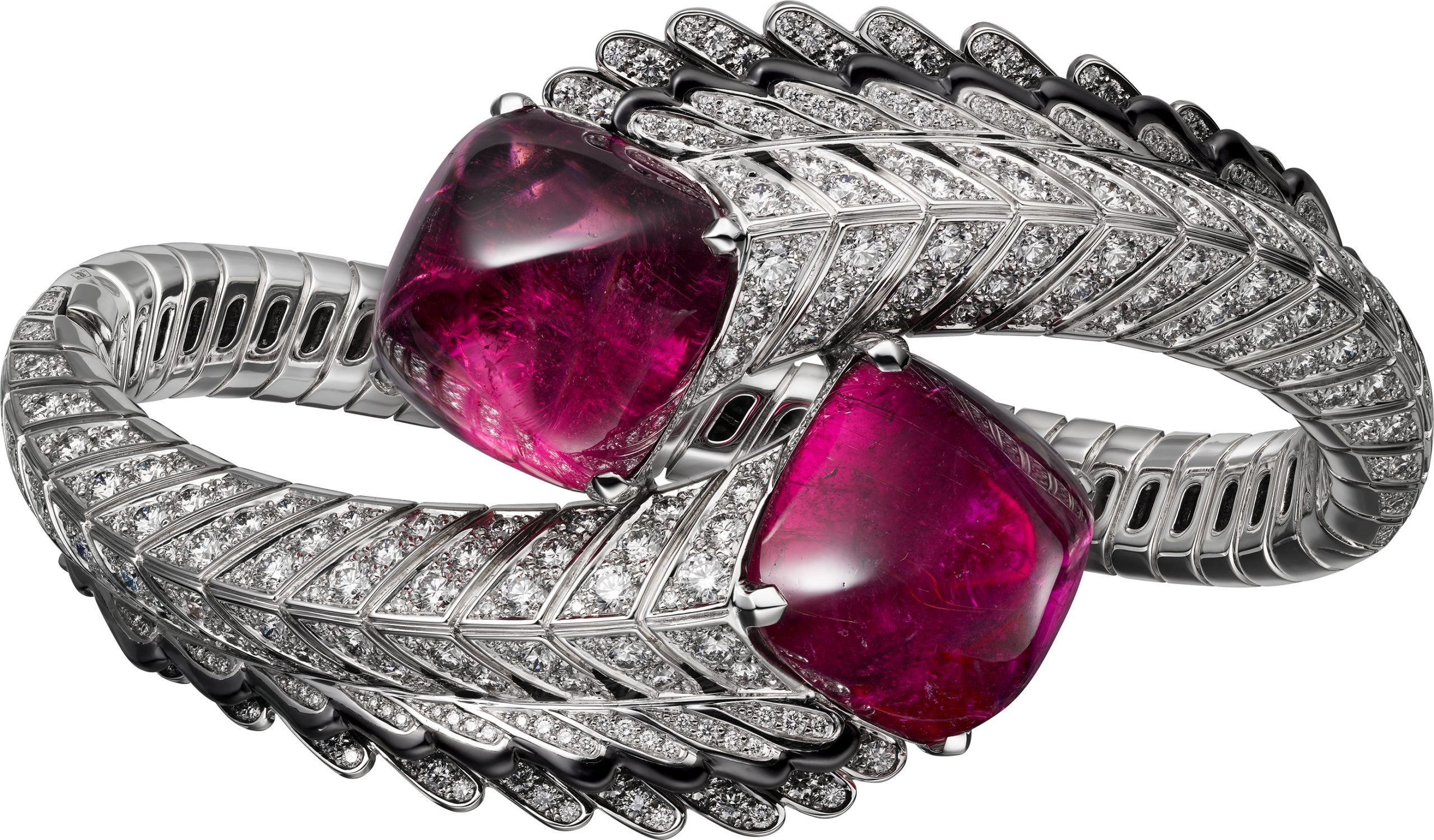
A gem of the tourmaline group, rubellite is valued for its flamboyant hue that can range from pink to red. Its strong color, along with the availability of large-sized stones, makes it extremely attractive and very commonly used in contemporary jewelry design.
- Mineral group: tourmaline
- Chemical composition: boron silicate compounded with aluminum, lithium and other elements
- Colors: pink to red
- Transparency: transparent to translucent
- Hardness: 7-8 (Mohs scale)
- Main sources of provenance: Brazil, Madagascar, Mozambique, Nigeria, Russia
Etymology, history and legends
Rubellite—from the Latin rubellus, meaning “glowing red”—is a pink or red variety of tourmaline whose hue can vary in intensity.
Tourmaline appears late in the history of gemology. The term “tourmaline garnet” was used in 1771, probably in reference to rubellite. Deposits discovered at the end of that century near Nerchinsk, in Siberia, yielded gem-quality rubellites that soon became very sought-after.
Demand grew strong in China after Cixi, the country’s Empress Dowager from 1861 to 1908, took a great liking to the stone. The rubellites in circulation at that time originated from rich deposits in California.
Famous rubellites
The Crown of Saint Wenceslas ranks among the finest of the Czech Republic’s Bohemian Crown Jewels and is said to feature the world’s oldest known tourmaline, dating from between 1346 and 1387. At that time it was believed to be a bright red ruby.
In 1925 a 260.86-carat bright pink stone from the Russian Crown Treasury—created by Peter the Great—which had also been considered a ruby until then, was determined to be a rubellite by Russian mineralogist Alexander Fersman. It is now on display in the Kremlin.
Colors and use
Rubellite has enjoyed unprecedented popularity in the past few decades, making it an increasingly desirable stone.
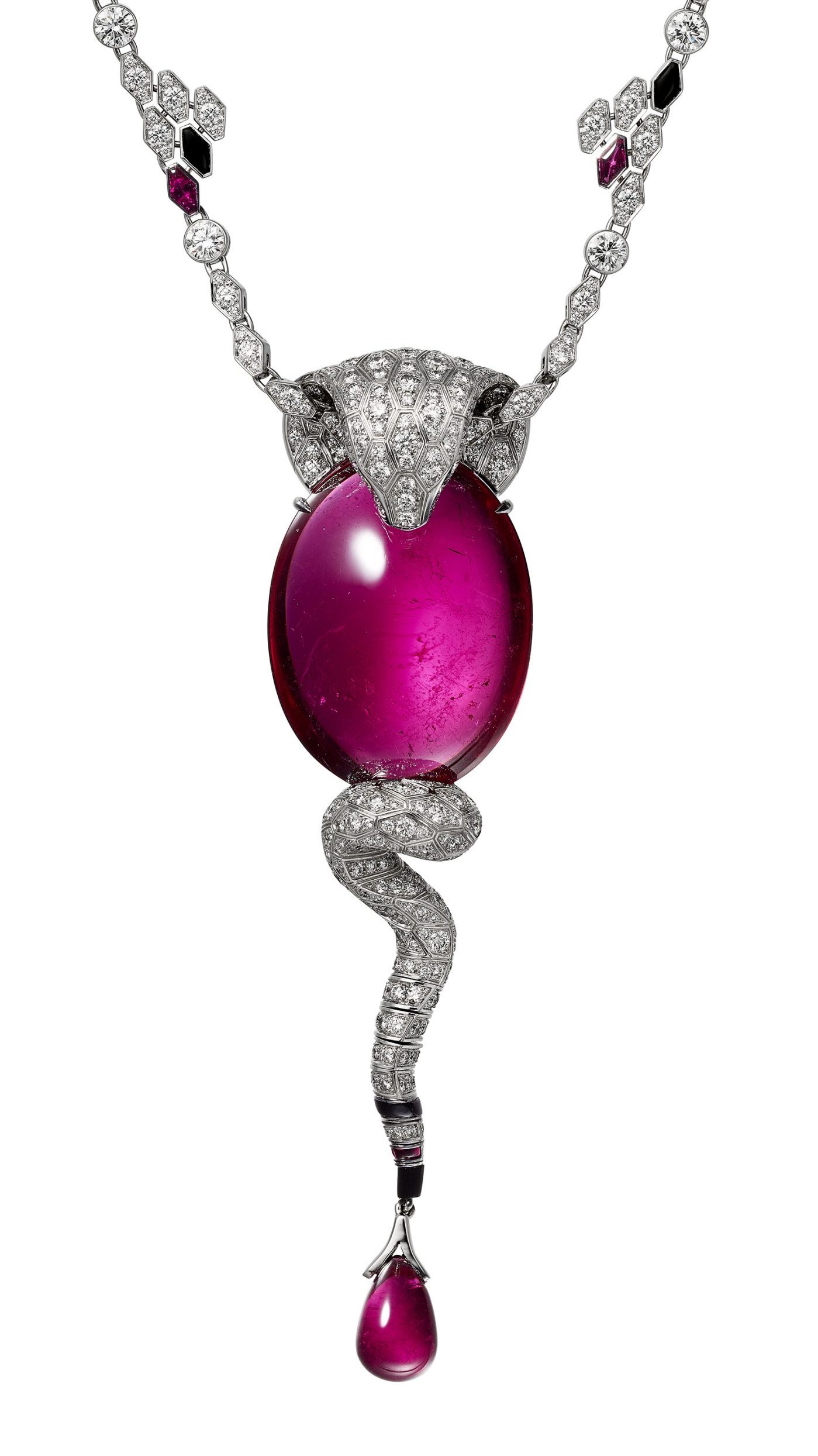
It is used in a variety of shapes and cuts—chiefly oval, cushion-shaped, faceted or cabochon. Specimens sized around fifty carats can be considered very fine stones.
The most magnificent of all are a luminous bright red. Stones of pinker hues are also highly prized for their vibrant raspberry color.
Formation of the stone
Rubellite forms in many environments, primarily in pegmatites (see tourmaline).
Origins
Brazil is renowned for the quality of its rubellites, especially those mined in the State of Minas Gerais. Nigeria, Mozambique and Russia are also rubellite-producing countries.
Certification
Gemological laboratories do not mention the geographical origin of tourmalines—including rubellites—in their reports.
Specific features
Cabochon rubellites and beads can contain quite a lot of inclusions, with minute crystals and needles inside the stone reaching the surface. These can give the stone a slightly blurred appearance.
Care recommendations
Despite its degree of hardness on the Mohs scale, tourmaline is softer than many other gemstones and, therefore, sensitive to scratches and heat.