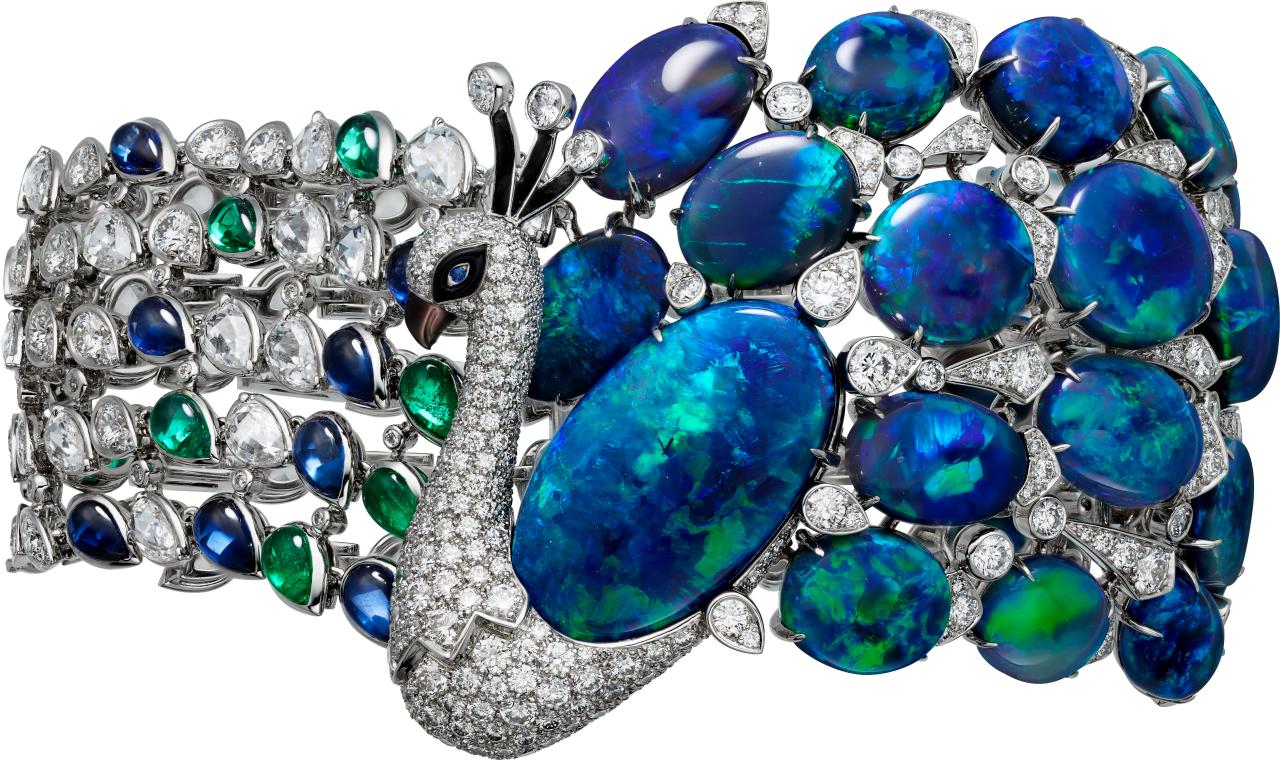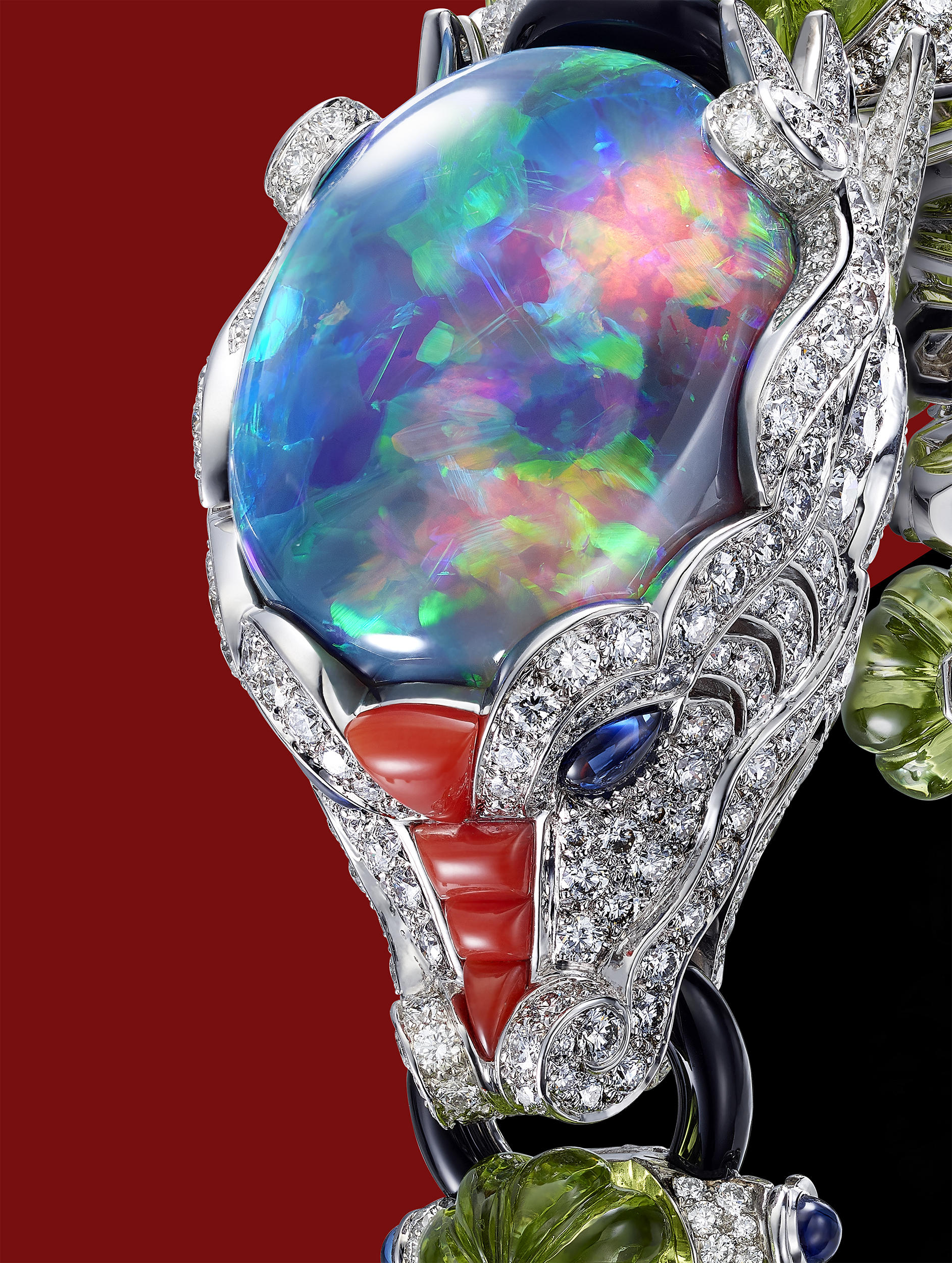
Opal, which is generally cut into cabochons, is immediately recognizable thanks to its splendid array of colors that vary depending on the angle of the stone. Pure blue or blue-purple, orange, yellow, green-yellow or green-blue… this exceptional palette is enhanced by Cartier in creations that burst with color.
- Mineral group: opal. Precious opal, which features a play of color, is distinguished from common opal, which has a single background color, or body color.
- Chemical composition: hydrated silica (silicon dioxide)
- Colors: a play of color including bright yellow, orange, green, blue, red or purple
- Transparency: transparent to opaque, essentially translucent
- Hardness: 5.5-6 (Mohs scale)
- Main sources of provenance: Australia, Ethiopia, Brazil
Etymology, history and legends
The name opal is probably derived from the Sanskrit upala, meaning precious “gem” or “stone.” Closer by, we have the Latin opalus and the Greek opallios.
Appreciation for precious opal has varied greatly over time. Slovakian mines introduced opal to Europe as early as Antiquity. The Greeks and Romans saw opal as a beneficial stone, considered to be a lucky charm, a sign of hope, good for eyesight, and capable of turning red in the presence of a friend or going pale before an enemy. However, by the end of the Middle Ages, opal had become the stone of thieves, as it was said to have the power to make one invisible.
Many legends have been told about opal. According to the Greeks, the tears of joy cried by Zeus following his victory over the Titans were transformed into opals upon touching the ground. For the Australian Aborigines, the stone, called “rainbow snake,” was created by the first god by taking the colors from a rainbow. According to an Arab legend, opal contains lightning whose fire has been imprisoned within the stone.
Walter Scott’s 1829 novel Anne of Geierstein: or The Maiden of the Mist describes an opal with a diabolic reputation. As a result of the book’s success, the stone was believed to bring back luck. The idea never fully took hold however, and opal became one of the most beloved stones in Germany. In Australia, it was even named the official national gem in 1993.
Famous opals
The first famous opal was that of the Roman senator Nonius. Mark Anthony (83–30 BC), who coveted the stone, threatened to banish the senator if he refused to give it to him. The senator preferred to be exiled… with his opal.
Joséphine de Beauharnais, the wife of Napoleon I, possessed an opal named “The Burning of Troy.” Weighing 700 carats, it was the most impressive opal of its time. Today, it is nowhere to be found.
In the 20th century, it became increasingly common to name exceptional opals. Among the largest and most beautiful were “Pride of Australia,” weighing 225 carats, and the 180-carat “Aurora Australis.” The “Andamooka” opal was given to Queen Elizabeth II in 1954 and, like the two aforementioned gems, originated in Australia.
Color and use
Opal is generally cut into cabochons with a more or less pronounced domed surface. Shapes range from the typical oval to the round, pear-shaped or drop-shaped stone.
Precious opal features a body color and changing nuances known as “play of color.”
This phenomenon is caused by the diffraction of light (deviation of light rays near opaque bodies) by the small, neatly stacked silica spheres which make up the opal. Play of color varies depending on where one looks and the angle of the gem. Diffraction must not be confused with opalescence, which refers to the milky blue background color of certain opals.
Opals come in several varieties:
- Solid precious opal, entirely composed of opal and generally traded under the simple name “opal.”
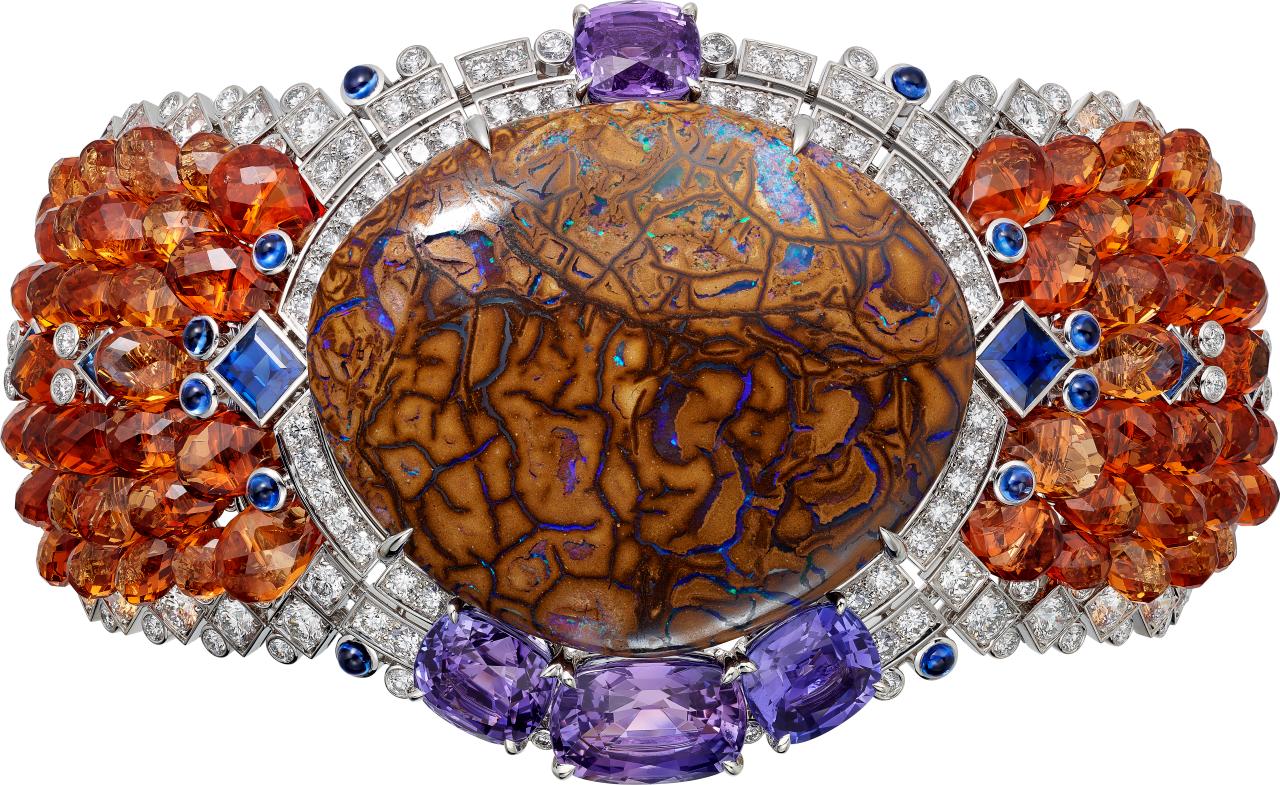
- Boulder opal, in which a host rock is traversed by thin veins of iridescent opal.
- Matrix opal, in which patches of opal are intimately distributed within the host rock and are visible at the surface.
Opals are evaluated based on the predominant shades in their play of color.
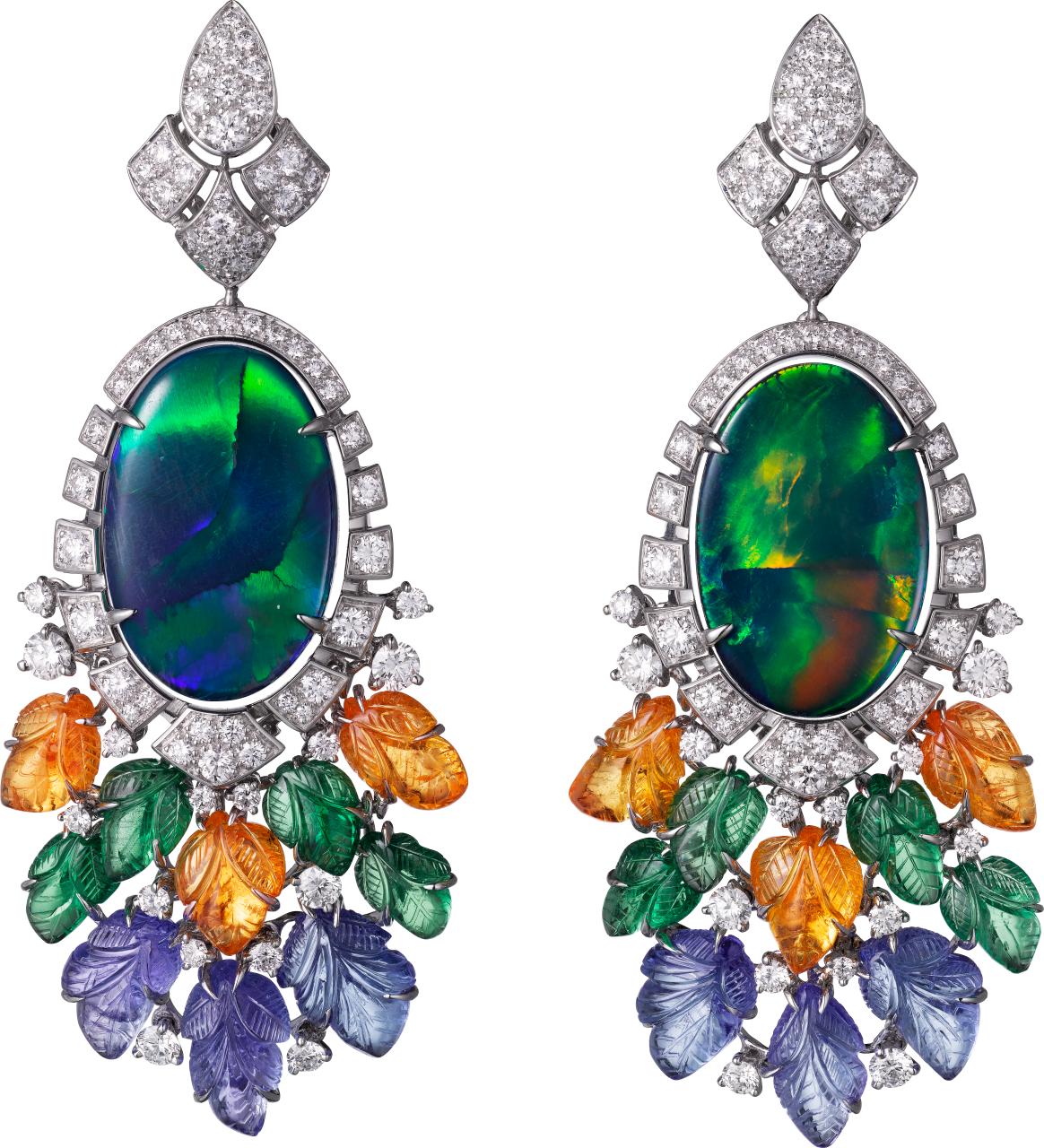
The most sought-after are black opals, which feature a mix of blue and green flashes. Rare specimens of this type of opal also contain flashes ranging in color from red to orange. Opals with a light bodycolor also offer multiple play-of-color effects.
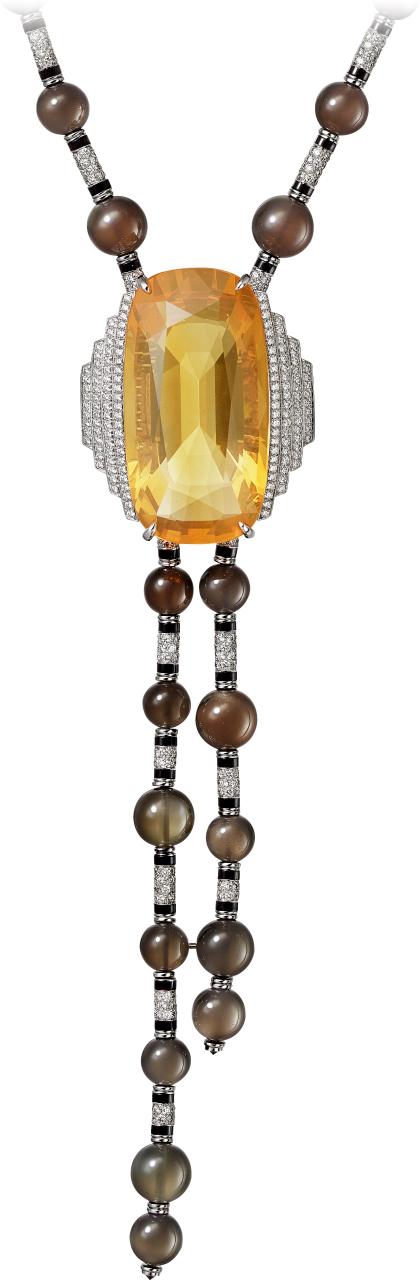
Fire opals exist in both the common and precious variety. They feature an orangish body color. The warmth of their color makes them attractive, but gem-quality fire opals are rare.
It is acceptable to see small amounts of the parent rock under the stone or along its edge, and sometimes in infinitesimal quantities on the stone’s top surface.
Formation of the stone
Opal is not a mineral in the strict sense of the term, but rather a combination of mineral matter. It is composed of silica (silicon dioxide), and more specifically of silica spheres arranged in neat stacks. The origin of opal was only recently understood. The stone is formed in close proximity to a volcanic environment. Opals are mainly mined in Australia, from sedimentary rock, or in Mexico, from volcanic rock.
Origins
Precious opals are mainly found in Australia, Ethiopia and Brazil. Orange fire opals originate in Mexico, Ethiopia and Madagascar.
Australia: The most famous mines are located in eastern Australia, in and around the Great Artesian Basin. The Lightning Ridge mines are famous for their black opals, Coober Pedy for their white opals, and Andamooka for their extremely transparent crystal opals and matrix opals.
The opal fields in Queensland produce boulder opals whose host rocks feature an exquisite brown hue coupled with attractive patterns.
Ethiopia: The Ethiopian mines, discovered at the end of the 20th century, are incredibly productive, particularly the Wello mines where white opals boasting varying degrees of transparency are found.
Other: Mexican mines mainly produce common, transparent, orange-hued fire opals.
Brazil produces opals of fine but lesser-known quality.
The United States and other countries produce opals in limited quantity.
Certification
Gemological laboratory reports are not required to specify an opal’s geographic origin, which cannot always be determined.
Care recommendations
Opals must be handled with care to avoid scratching or chipping. They do not withstand rhodium-plating, ultrasound, chemical treatments or excessive heat.
Certain opals are hydrophanes. This means they can absorb liquids which, in excess, make them fragile and transparent. Cartier takes care to select only opals that have undergone laboratory testing to avoid this risk.
Cartier and opals
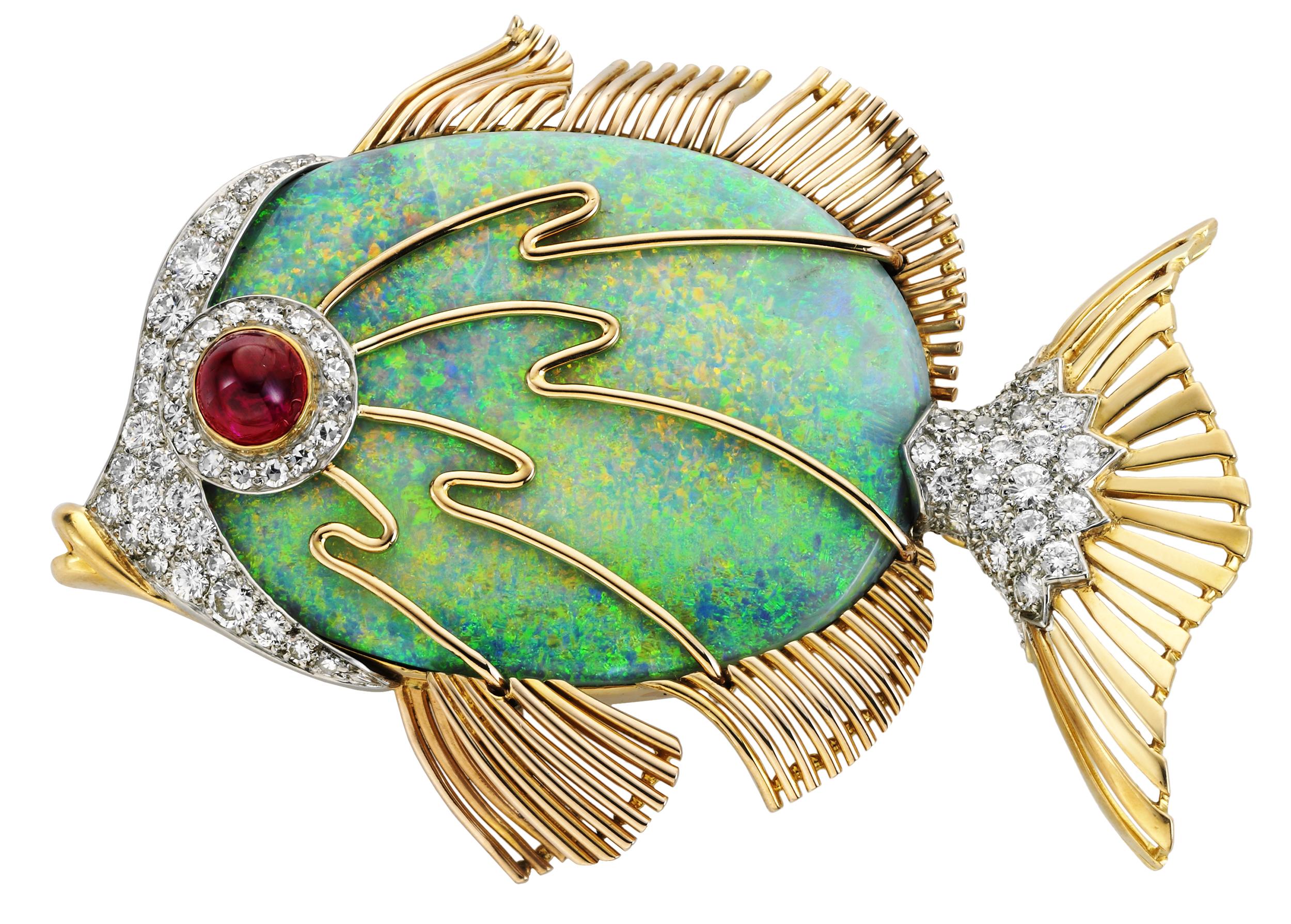
Opal, with its varied shapes and vivid, shifting colors, belongs to that class of singular, intriguing gemstones that Cartier finds so fascinating. It was little used prior to the 20th century but gained prominence during Jeanne Toussaint’s reign as Creative Director from 1933 to 1970. She reveled in its evocative power, incorporating it into a host of pieces including animal brooches where it beautifully reproduces the blue-green plumage of a kingfisher or the iridescent scales of a fish.
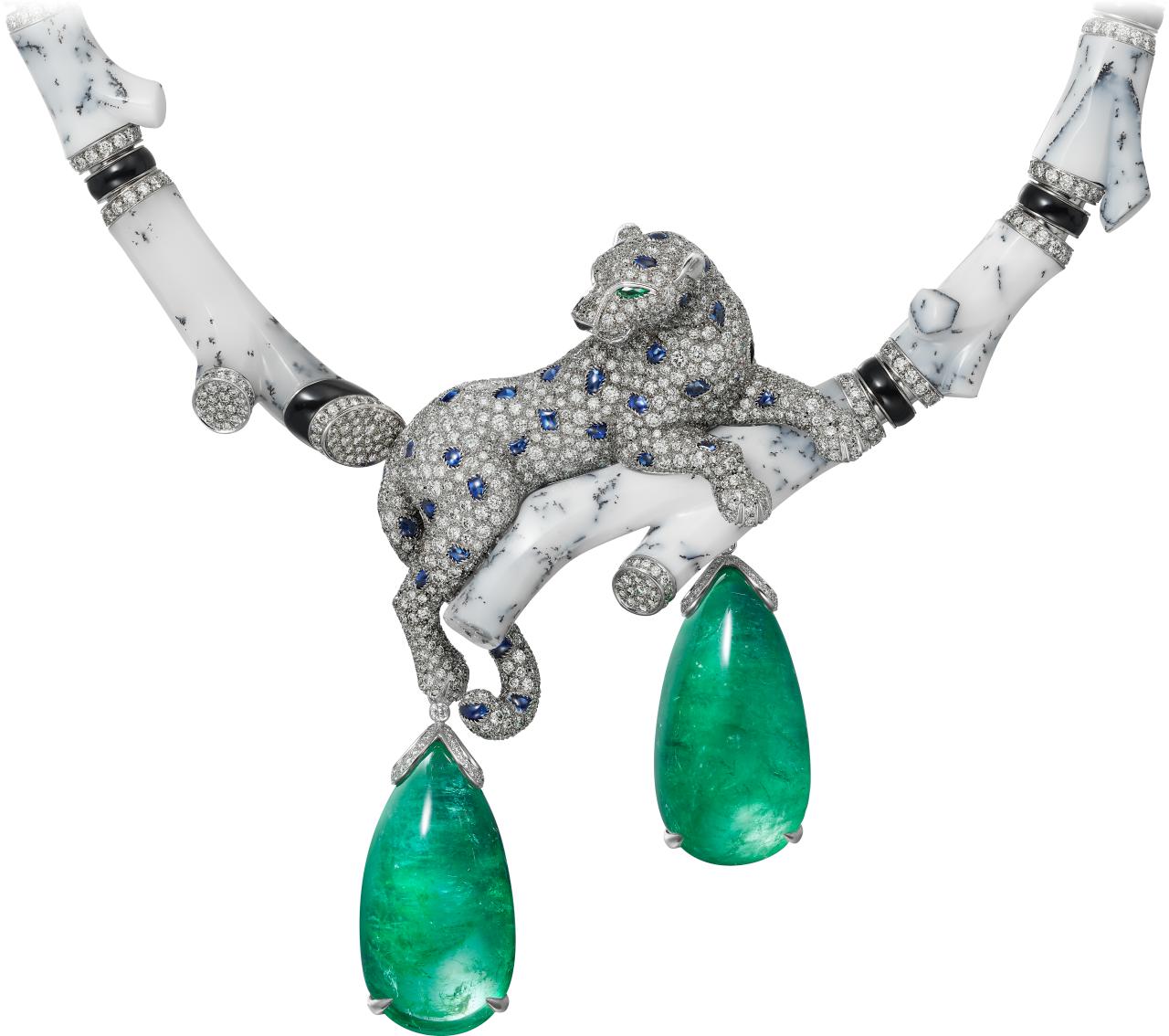
With the discovery of the Ethiopian deposits in the late 20th century, opal’s aura intensified and it took the limelight at Cartier, gloriously showcased in High Jewelry sets. The variety of organic forms and patterns in opal is a continuing inspiration to the Maison. In a 2018 brooch, the jeweler toys with the suggestive power of a boulder opal to convey a chameleon and its changing colors. A 2019 necklace brings the characteristic inclusions in a dendritic opal into play to suggest a woody texture.
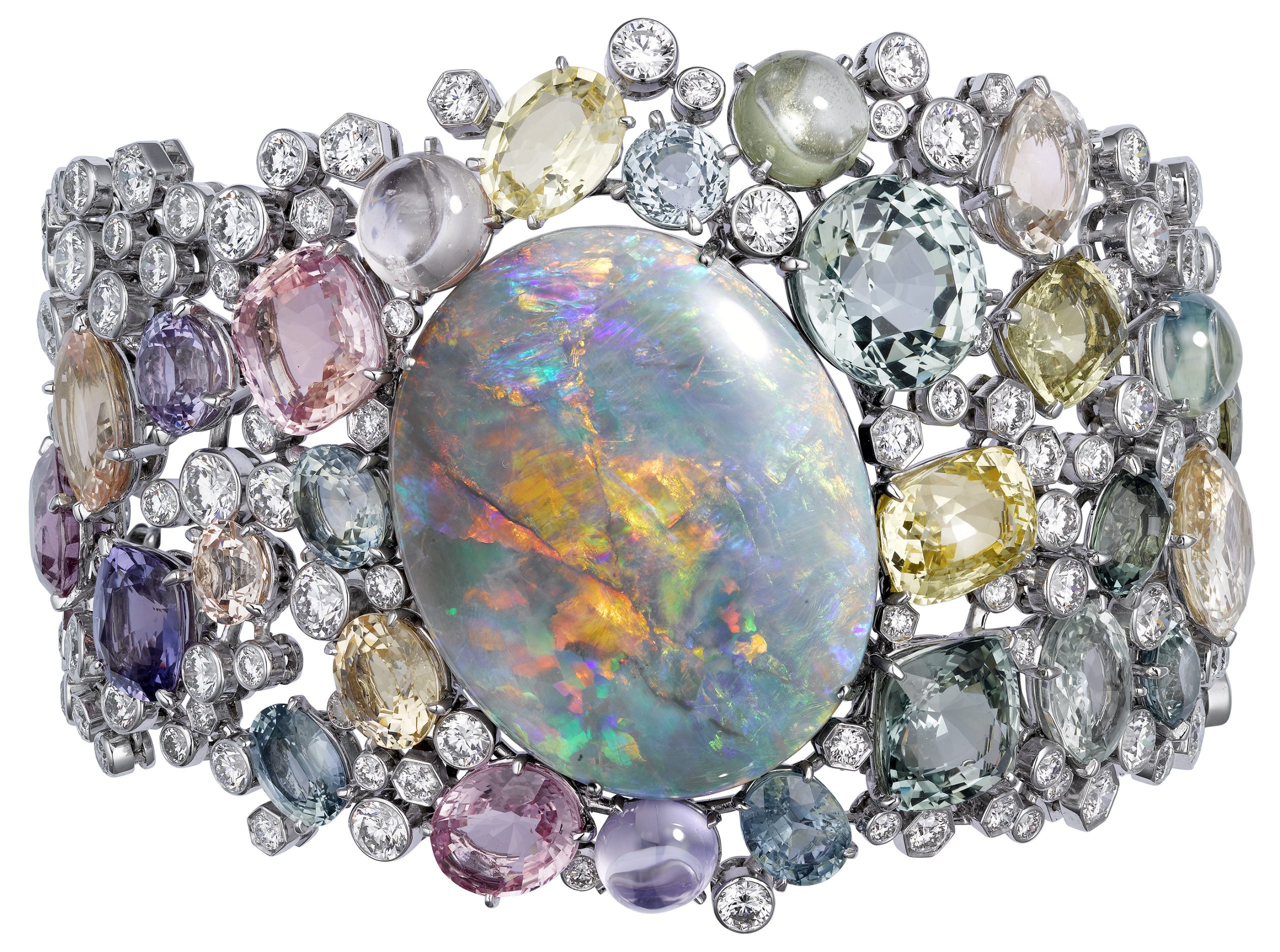
The Maison also displays its talents as a colorist by drawing together a precious palette of other stones to exalt the opal’s beauty. Gems such as blue or fancy sapphires, emeralds, tourmalines and garnets echo opal’s deep nuances in a fascinating show of fireworks. These chromatic compositions demonstrate Cartier’s mastery of color, of achieving perfect balance and harmony between them. Harking back to its early, bold color combinations from the dawn of the 20th century, Cartier skillfully juxtaposes stones in accords of striking visual force: purples and blues mingle with brown to echo the veining inside a stone; turquoise is married with fuchsia; gray melts into pastel colorways of pinks, yellows and mauves; green is set alongside orange.
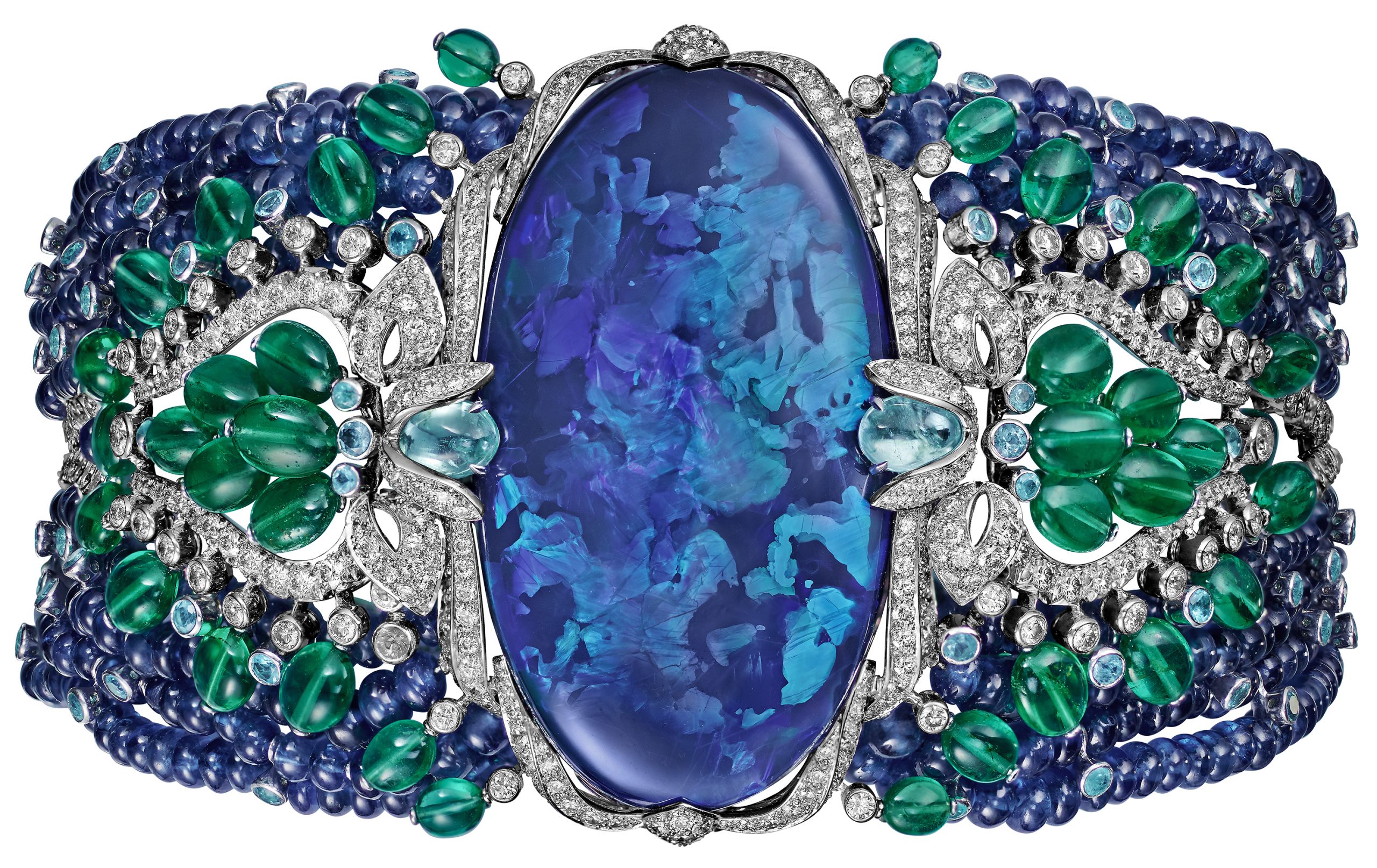
Among all these combinations, there is one that stands out: green and blue. It has become emblematic of the Maison since Louis Cartier first employed it in the early days of the 20th century, originally using emerald and sapphire – or, more rarely, jade or lapis lazuli. The characteristic mixture of blues and greens visible in black opal means this stone lends itself particularly well to highlighting this palette. Louis Cartier called the blue-green color match his “peacock pattern” in reference to the bird’s plumage, and since then the Maison has crafted many new interpretations of this striking combination around black opals.