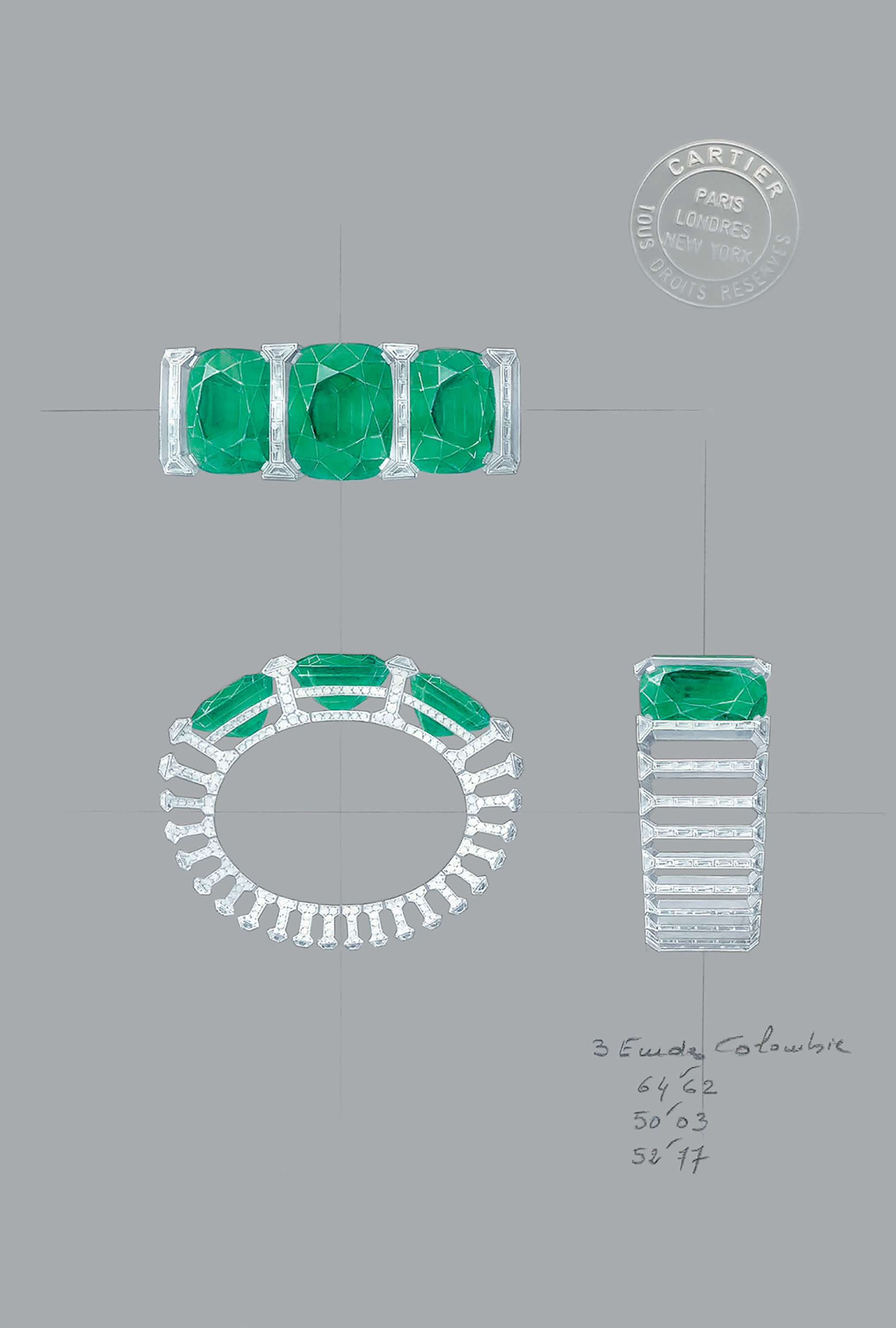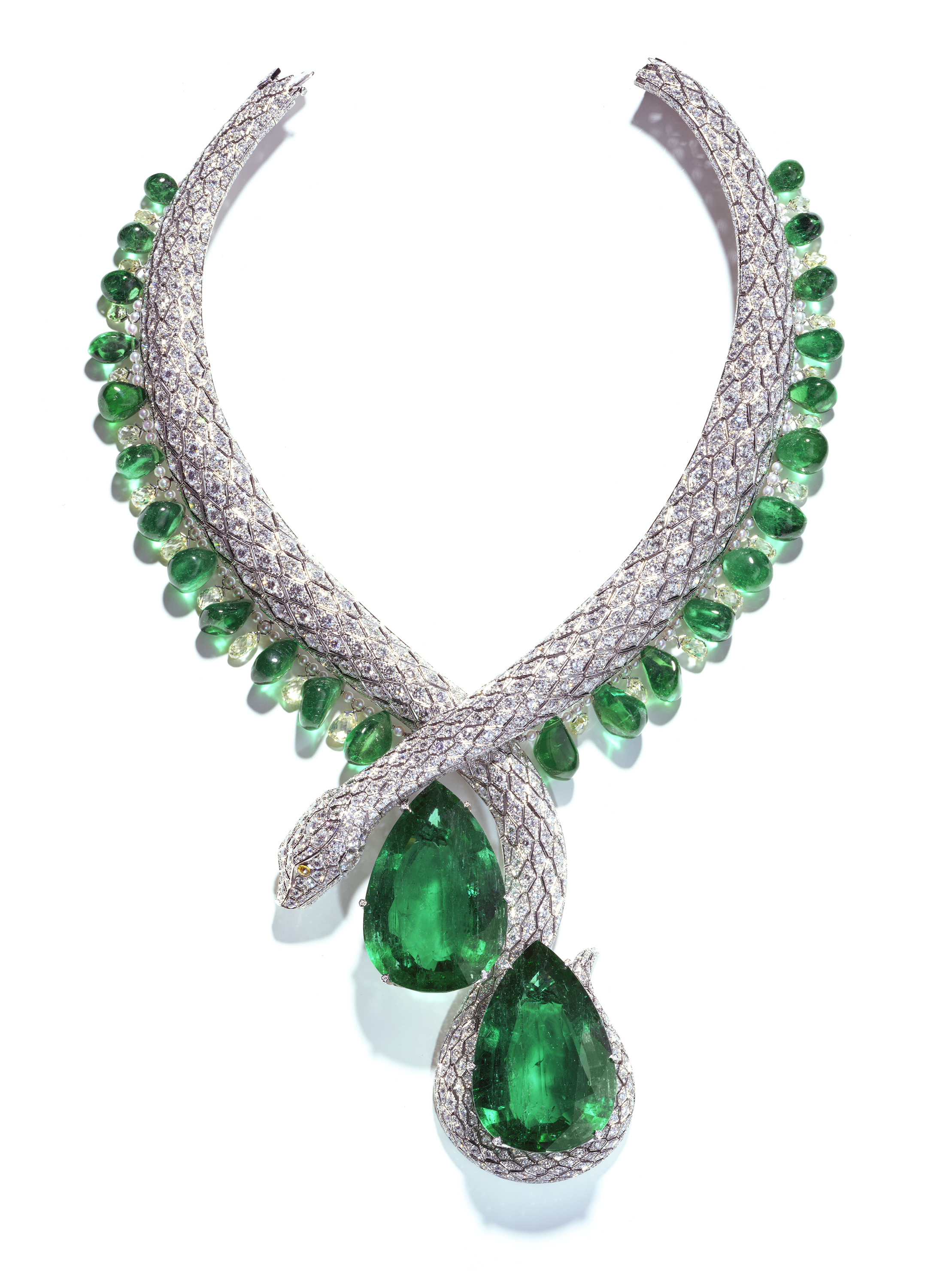
In 1997 Cartier displayed five extraordinary emeralds cut from the same rough stone weighing 2,500 carats, found in the Chivor mine in Colombia. Two of them, pear-shaped and weighing 205.11 and 206.23 carats respectively, adorned a supple snake necklace whose scales were pavé-set with diamonds. The three other emeralds, of 50.03, 52.77, and 64.62 carats, were set on a spectacular bracelet.
Chivor is located 125 miles northwest of Bogota, Colombia, in the foothills of the Cordillera Oriental. It is well known to seekers of emeralds and lovers of extraordinary stones. The mine, originally worked by native peoples until the late 1530s, fell into the hands of Spanish conquistadors who made the most of this source of the world’s purest emeralds: impurities were eliminated during the crystallization process thanks to a saline solution naturally present in the rock. Chivor emeralds, deep green with a tiny hint of blue—became coveted objects the world over.
Abandoned in 1675, the mine was forgotten. It was only in the 1800s, after Colombia declared its independence, that the mine was reopened.
In 1994, a raw stone weighing 2,500 carats was brought up. Its quality was so good that stonecutters could get five wonderful emeralds from it: two were pear-shaped, weighing 205.11 and 206.23 carats respectively, and the three others were octagonal, weighing 53.84, 58.45, and 67.87 carats. Cartier acquired this unique set and had the three smallest ones recut into cushion-shaped stones, which today weigh 50.30, 52.77, and 64.62 carats.
In 1997, to celebrate the Maison’s 150th anniversary, the two pear-shaped emeralds were set on a spectacular snake necklace reflecting Cartier’s unmatched tradition of naturalistic animal jewelry.
Seven years later, in 2004, the three cushion-shaped stones were placed side-by-side on a white-gold bracelet set with baguette- and brilliant-cut diamonds.