

Brazilian aviation pioneer Alberto Santos-Dumont (1873–1932) was both a client of the Maison and a personal friend of Louis Cartier, who designed the famous watch for him that now bears his name.
Early years in Brazil
Alberto Santos-Dumont was born in 1873 in Palmira,—a city since renamed in his honor—to Brazilian aristocrat Francisca dos Santos and her husband Henrique Dumont, an engineer of French descent. The boy grew up in Brazil on his father’s coffee plantation, which was the source of the family’s fortune. From a very young age he learned to repair agricultural machinery, and no doubt this, coupled with Jules Verne’s adventure novels, inspired Santos-Dumont’s life-long passion for machinery and mechanics. He studied for a time at the Ouro Preto Escola de Minas engineering school. But after he turned eighteen in 1891, his father suffered a serious riding accident and decided to sell his estates and leave South America for Paris. Santos-Dumont briefly returned to live in Brazil in 1896, before settling permanently in France in 1898.
A pioneer of modern aviation
The Belle Époque was at its zenith in late 19th-century Paris, with the Eiffel Tower a striking new addition to the urban skyline, early automobiles rolling down Haussmann’s grand boulevards, and avant-garde art overthrowing all the conventions. The city provided fertile ground for Alberto Santos-Dumont to channel his ingenuity and passion for aviation into bold experiments. He used the wealth inherited from his father to bankroll a series of ambitious aeronautical designs. As a pioneer of manned flight, he was constantly distinguishing himself through novel exploits and setting new challenges. After a remarkable first ascent with French engineer Alexis Machuron, Santos-Dumont went on to have the world’s smallest hot air balloon made.
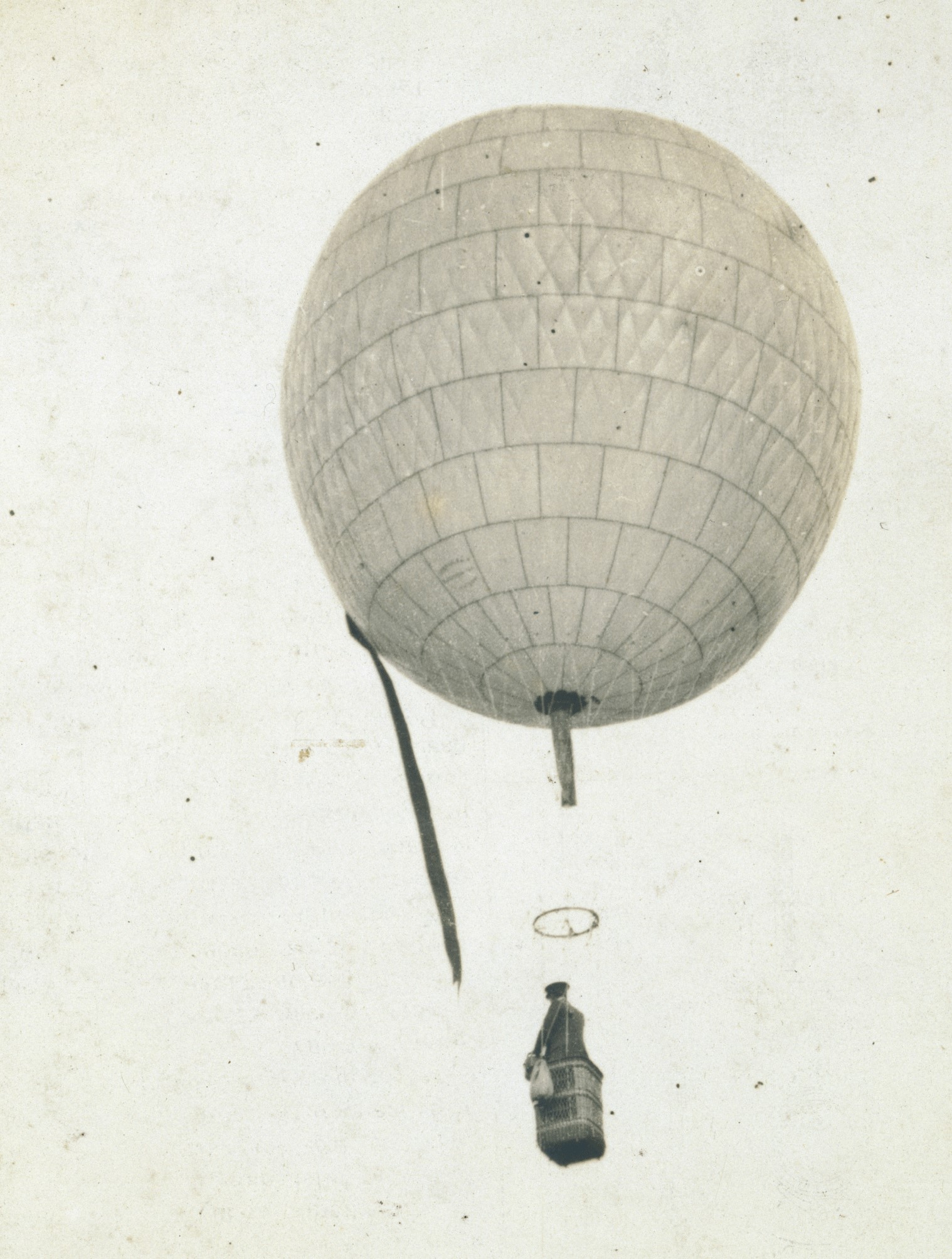
The “Brazil” was inaugurated in 1898 with a maiden flight lasting almost five hours. Following this early success, Santos-Dumont was still frustrated by the limitations of the craft—chiefly the fact that there was no way of steering it—and so he set out to design a dirigible balloon. After many attempts, he made history in March 1901 by flying his No. 5 airship about 45 kilometers around Paris in four hours, a world first. A few months later, he won the prize offered by industrialist Henry Deutsch de la Meurthe for covering the distance between Saint Cloud airfield and the Eiffel Tower in under thirty minutes.
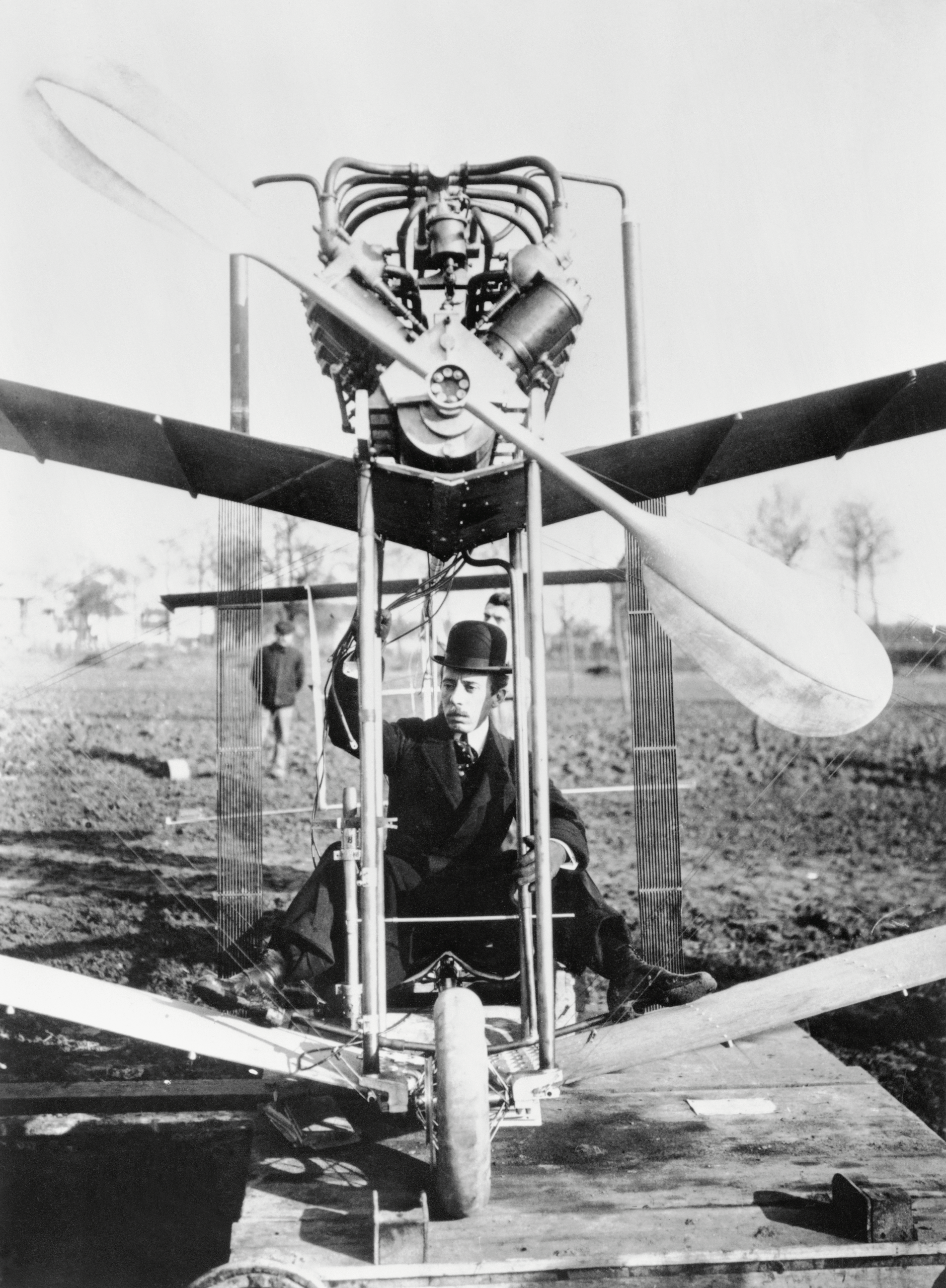
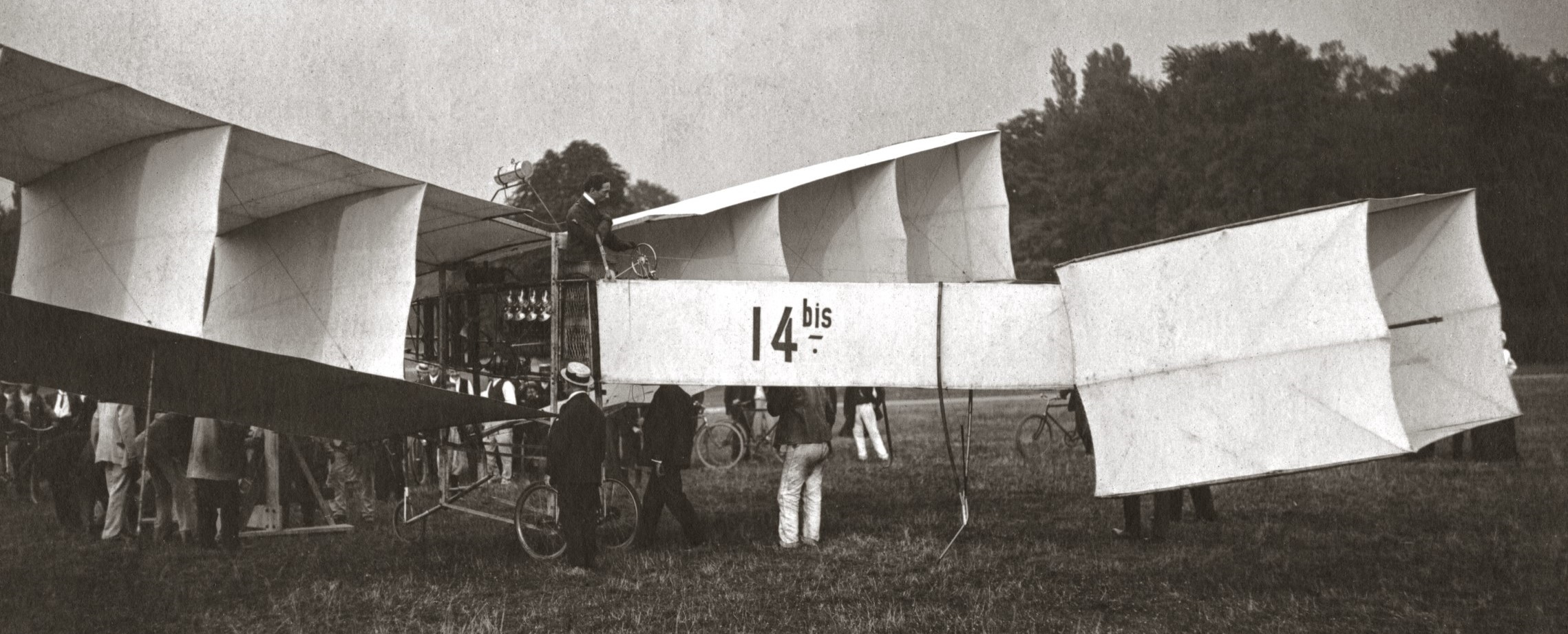
A tireless inventor and visionary, Santos-Dumont sensed that the future of aviation lay in another type of craft, the airplane—or “heavier-than-air” craft, to use the expression coined by Nadar to describe flying machines as opposed to balloons. One of the Brazilian’s greatest triumphs was the “14 bis” airplane, which won him several competitions. This craft enabled him to execute one of the earliest flights of a motor-powered aircraft observed by officials. In November 1906 he also set the first world aviation record by flying about 220 meters in 21.2 seconds at an altitude that varied between 2 and 5 meters and a speed of about 40 km/h—an unprecedented feat. The following year Santos-Dumont distinguished himself again with the Demoiselle, the first light aircraft in aviation history. This was the last aircraft he designed and flew before retiring from aviation.
The following year Santos-Dumont distinguished himself again with the Demoiselle, the first light aircraft in aviation history. This was the last aircraft he designed and flew before retiring from aviation.
The birth of the Santos de Cartier wristwatch
No one is sure of the exact date when Alberto Santos-Dumont and Louis Cartier met for the first time, but it is certain that they were friends. Moving in the same high society
—Santos-Dumont was a renowned host— and both having a taste for elegance, the two were drawn together by their shared passion for modernity and the technological inventions of their times.
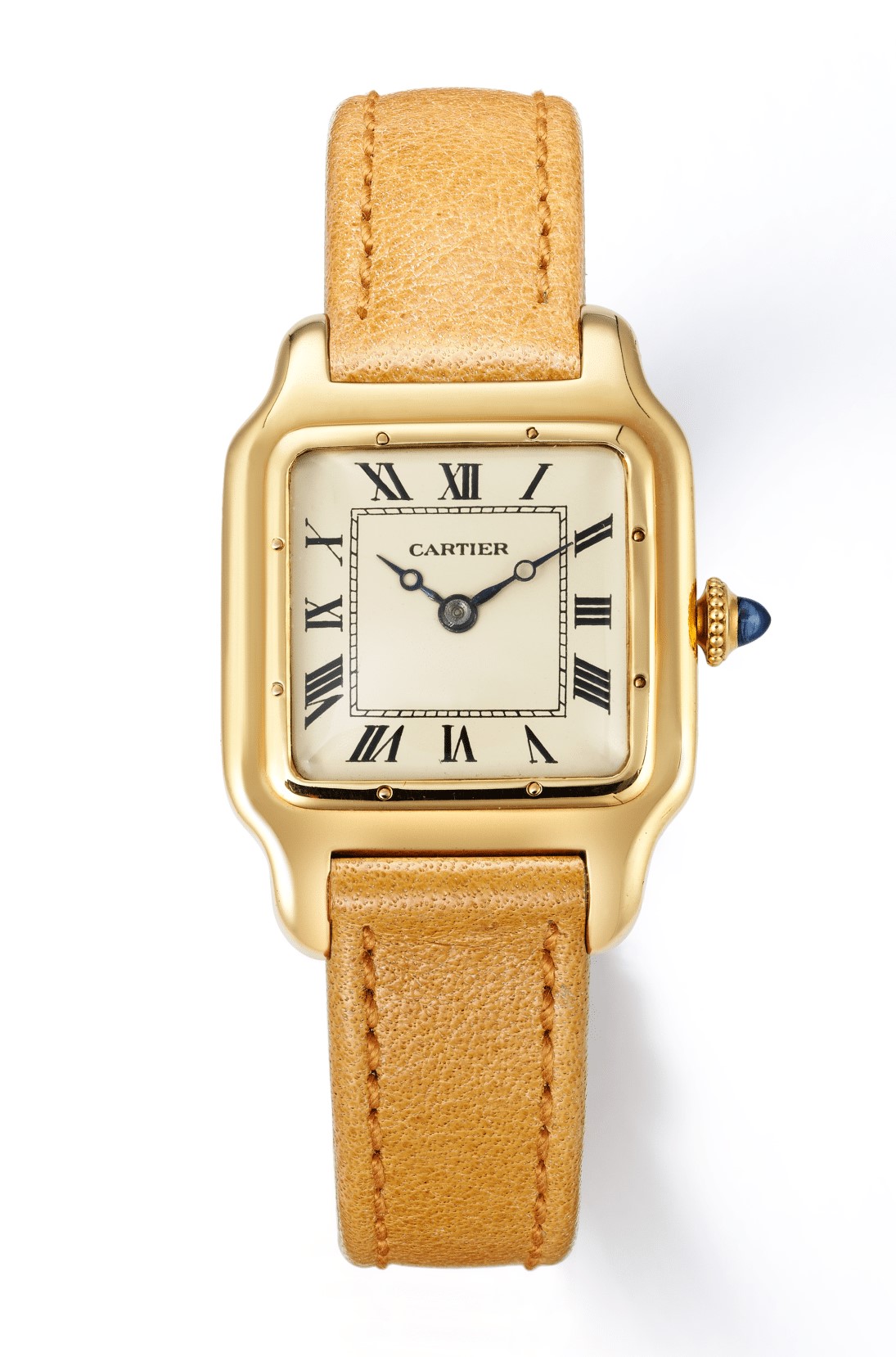
As an aesthete and a visionary in his own field, Louis opened up new creative avenues for the Maison, particularly with regard to watchmaking. He was keen to solve a problem Santos-Dumont was said to have laid before him, namely the difficulty of reading the time on his traditional pocket watch when out flying—he had to let go of the controls to pull it out. Cartier’s response in 1904 was to come up with a design that displayed its dial immediately, allowing the aviator to keep his hands free for the controls during flight.
And so the Santos de Cartier wristwatch was born. It was the first modern timepiece, specifically intended to be worn on the wrist—a real turning point in the history of watchmaking.