

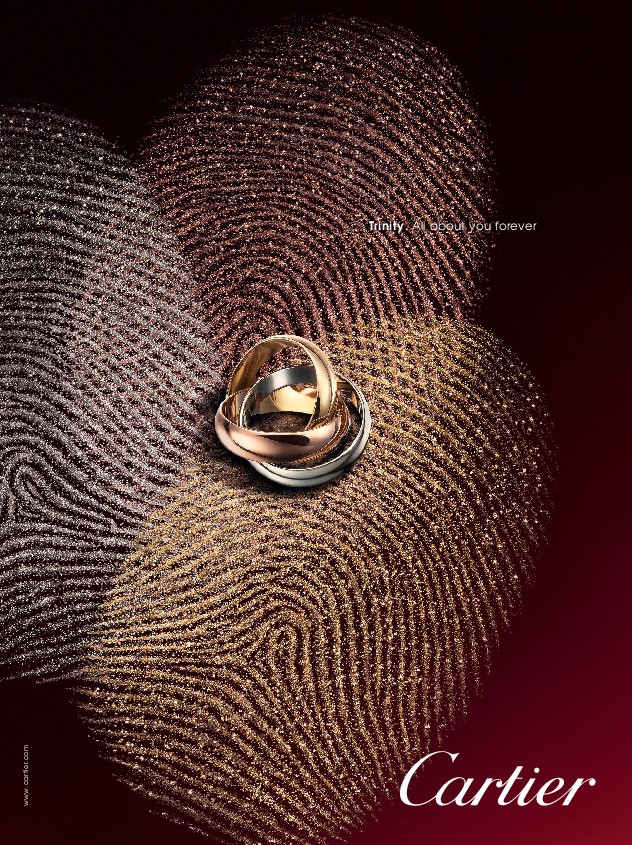
Created by Cartier in 1924, the Trinity ring has taken its place as one of the Maison’s emblems and an icon in the world of jewelry.
The mention of a ring intertwining three inseparable bands first appeared in the Maison’s registers in 1924. It was executed in platinum (later replaced by white gold), pink gold, and yellow gold, respectively. That same year, a bracelet was also created.
It seduced Elsie de Wolfe, a famous American interior decorator, who would be one of the first to acquire it.

The French poet Jean Cocteau chose the ring in the 1930s. He wore it in an original way, which would become his signature: two of them stacked on the little finger of his left hand. Many figures of their time imitated him, including Jean Marais, Alain Delon, Romy Schneider, Grace Kelly, and Gary Cooper.



Until the 1970s, what was still called “the three-band ring” went through a wide variety of interpretations: plays of colors and textures, multiplication of the bands—up to ten! An inexhaustible creative source, since the clean lines of its design offered innumerable possibilities.
In 1981, the Maison relaunched the ring under the name “Trinity.” This designation initially referred only to the medium-sized model. It was not until 1997 that the entire collection adopted this name. It was gradually enriched with additional pieces throughout the first years of the new millennium, from the sautoir to pendant earrings, from the cord bracelet to the engagement ring, from all-gold versions to paved ones, by way of a ring including a black ceramic band.

In 2022, Cartier and Chitose Abe, founder of the Sacai brand, merged their vison of Trinity to propose a series of six limited-edition pieces. This creative encounter, born of a dialogue between the Japanese designer and the Cartier jewelry studio, perpetuates a long tradition of the Maison, accustomed to these joint style exercises when working on the development of special orders. For the first time, they gave rise to a collection intended for the general public, which reveals new facets of Trinity, notably bold ways of being worn.

Over the century, Trinity has acquired the undeniable rank of icon, thanks to the timelessness of its design as well as its universal character: a mixed, transgenerational, playful piece, rich in multiple symbols and with a fascinating power of appropriation. Through the number and colors of the bands as well as their intertwining, Trinity celebrates the diversity of bonding relationships and all forms of love.